
Chongfan Technology
News
02
2026
-
07
The Symposium on Coordinated Observations for Solar Three-Dimensional Exploration Was Held in Lenghu.
Author:
The Sun is the primary driver of variations in the Sun–Earth space environment. Three-dimensional solar exploration, achieved through coordinated observations from multiple orbits, platforms, and vantage points, overcomes the limitations of single‑spacecraft or ground‑based measurements and represents a critical pathway for addressing fundamental scientific challenges—such as the origins of the solar magnetic field, the mechanisms behind solar storms, and coronal heating—while enhancing our ability to forecast the space environment.
To fully leverage the advantages of existing and ongoing domestic space- and ground-based multi‑angle observation missions—including Kuafu‑1, Fengyun‑4, Xihe‑1, SPO, the Sun–Earth L5 exploration project (Xihe‑2), heliocentric observations, close‑approach probes, AIMS, NVST, and WeHoST—a symposium on coordinated stereoscopic solar observations will be held from June 16 to 19, 2026, at the Lenghu Astronomical Observatory Research Base in Haixi Prefecture, Qinghai Province.
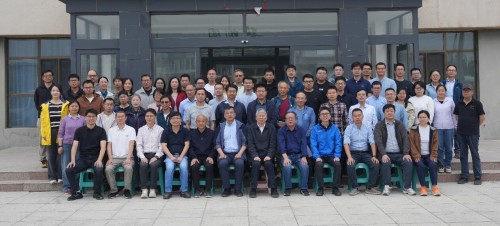
This conference brought together more than sixty experts and scholars from China’s solar physics, space physics, and aerospace engineering communities, who engaged in comprehensive discussions on cutting-edge topics including three-dimensional exploration results, on-orbit satellite operations, future mission planning, and ground-based observational collaborations.
The conference was honored by the attendance of Academician Yang Mengfei from the China Academy of Space Technology and Academician Wang Chi from the National Space Science Center of the Chinese Academy of Sciences. The presentations spanned multiple research areas, systematically reviewing the overall framework for SPO’s scientific output in light of existing space-based observation missions and their development plans; highlighting the synergistic advantages of joint multi-mission observations among LAVSO, SPO, and L1; summarizing the current status and upgrade roadmap of the FY‑4 satellite’s solar observation operations; and outlining the in-orbit stereoscopic exploration results of the Kuafu‑1 mission along with prospects for its further expansion. The conference also reported on progress in building the ground‑based solar observation support infrastructure under the Meridian Project, provided detailed explanations of the scientific objectives, orbital designs, and cutting-edge technological pathways for next‑generation missions such as the Sun–Earth Lagrange‑point observation program and close‑proximity solar exploration, and showcased the latest advances in digital modeling of solar storms, offering theoretical underpinnings for the inversion of stereoscopic observational data. Furthermore, drawing on practical requirements of space environment forecasting, the event assessed the early‑warning value of stereoscopic observation data and explored feasible approaches for coordinated observations between geostationary satellites and deep‑space exploration platforms.
The entire academic symposium featured tightly integrated topics, encompassing a review of current in-orbit missions, ground-based observational support, plans for next-generation satellites, theoretical and numerical simulations, and operational applications in space weather, thereby providing a comprehensive, end-to-end platform for exchange across the “scientific research–engineering development–operational application” continuum.
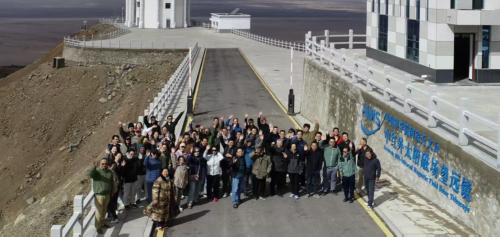
Following the meeting, all participating experts traveled to the Lenghu Astronomical Observatory Research Base for an on-site inspection. They assessed the operational status of the ground-based solar observation facility AIMS, the storage of observational data, and the interoperability of multi-platform data, among other practical aspects. In conjunction with the site’s observing conditions, they engaged in a field discussion on the coordinated mechanism for integrated space–ground three-dimensional observations.
This symposium on coordinated observations for three-dimensional solar exploration comprehensively reviewed China’s existing capabilities, identified key shortcomings, and outlined pathways for future development. By fostering consensus and pooling resources, it aims to advance the systematic construction of a multi‑viewpoint, multi‑wavelength, multi‑orbit three-dimensional solar observation network, thereby significantly bolstering cutting‑edge research in solar physics and enhancing space weather forecasting and protection capacities. This effort will further consolidate China’s leading position in the international arena of solar exploration.
Source: National Astronomical Observatories
LATEST NEWS
Thank you for visiting the official website of Chongfan Technology. If you have cooperation intentions or suggestions, please contact us through the following methods, and we will reply as soon as possible, thank you!
Address: Room 403, Building 6, Phase III of R&D, No. 36 Xiyong Avenue, High tech Zone, Chongqing, China.
Telephone: +86-13658337211
E-mail: Sales@cfkeji.net
Website: www.cfkeji.net
Mobile Version