
Chongfan Technology
News
01
2026
-
06
Skyrmions Based on Optical Anisotropy
Author:
The Chao He group at the University of Oxford has developed an abstract parameter-space dimensionality-reduction technique that extends the skyrmion framework to fields whose values reside on manifolds of dimension greater than two, thereby broadening the range of systems capable of hosting skyrmions. To demonstrate that this is more than a mere mathematical abstraction, the authors applied their method to light–matter interactions, encoding skyrmionic structures directly into the spatially varying optical anisotropy of structured materials by selecting a specific axis. This approach differs fundamentally from skyrmions formed by director fields in liquid crystals. As a proof-of-concept platform, the authors employed an array of tunable elliptical retarders based on liquid crystals, experimentally realizing such skyrmions and demonstrating complex, reconfigurable skyrmionic states that exhibit topological robustness even under deliberately introduced random perturbations. Leveraging this robustness, they showcase a promising application of skyrmions for topologically protected information storage and propose an easily verifiable rule—referred to as the “60° rule”—which serves as a practical engineering guideline for ensuring resilience against noise and measurement errors.
The research findings were published on May 27, 2026, in Light: Science & Applications, under the title “Skyrmions based on optical anisotropy for topological encoding.”
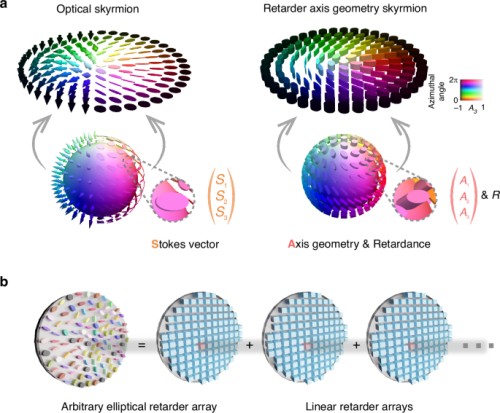
Figure 1: Concept Map
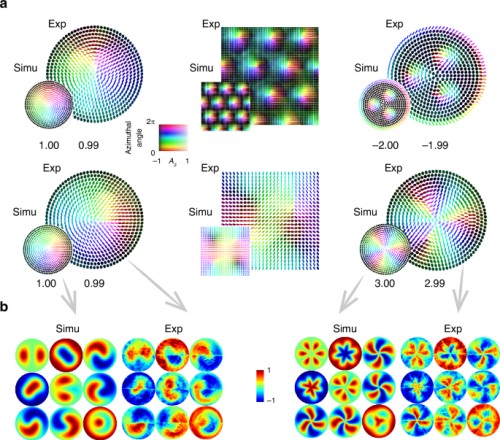
Figure 2: Formation and characterization of skyrmions based on optical anisotropy.
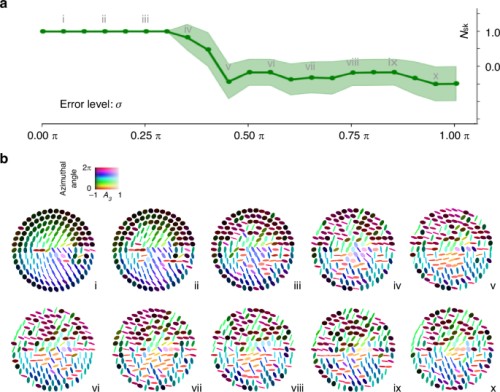
Figure 3: Number of Néel-type AGB skyrmions and matter-field configurations under increased perturbations.
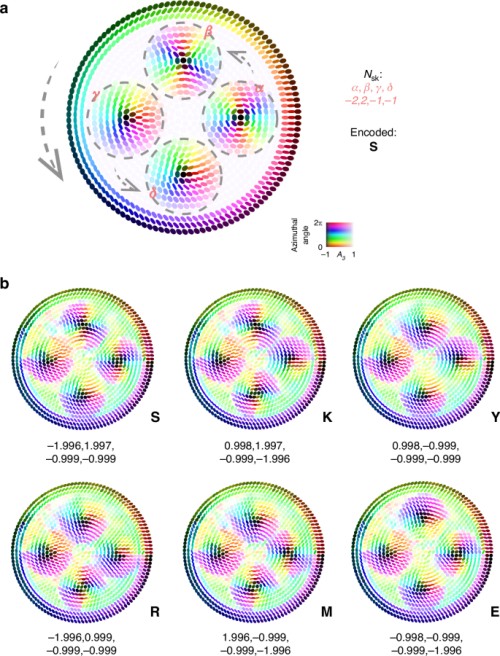
Figure 4: AGB skyrmion bag used for encoding topological information
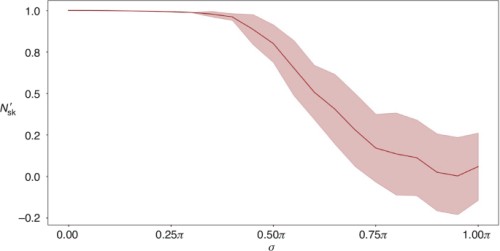
Figure 5: Simulated skyrmion number under perturbation
Source: Optics World
LATEST NEWS
Thank you for visiting the official website of Chongfan Technology. If you have cooperation intentions or suggestions, please contact us through the following methods, and we will reply as soon as possible, thank you!
Address: Room 403, Building 6, Phase III of R&D, No. 36 Xiyong Avenue, High tech Zone, Chongqing, China.
Telephone: +86-13658337211
E-mail: Sales@cfkeji.net
Website: www.cfkeji.net
Mobile Version