
Chongfan Technology
News
25
2026
-
05
Highlight | A Portable Frequency-Stabilized Laser with Hertz-Level Integrated Linewidth Based on a Solid-State WGM Microcavity
Author:
Photonics Research 2026 Issue No. 4 of the Year: Editors’ Pick:
Recommended reading:
Currently, ultra‑stable laser schemes based on Fabry–Perot cavities are typically bulky and require high‑vacuum systems and sophisticated vibration isolation, making them ill‑suited for non‑laboratory settings. To address this technical bottleneck, researchers from Peking University and other institutions have, for the first time under ambient pressure and room temperature, demonstrated laser operation using a portable solid‑state MgF₂ whispering‑gallery‑mode microcavity, achieving a hertz‑level integrated linewidth of 4 Hz and a fractional frequency stability of 2.5 × 10⁻¹⁰ over 10 ms. Compared with conventional ultra‑stable cavities, this device eliminates the need for vacuum and active vibration isolation, with a compact package roughly the size of a palm, while delivering both high performance and robustness. Its ingenious design holds significant potential for engineering applications, providing critical components for field‑deployable precision measurement technologies such as portable optical atomic clocks, high‑accuracy navigation, and remote sensing, and paving the way for ultra‑stable lasers to move beyond laboratory environments into a broader range of practical use cases.
—— Researcher Zhou Jiaqi, Shanghai Institute of Optics and Fine Mechanics, Chinese Academy of Sciences
Photonics Research Young Editorial Board
Ultra‑stable lasers are essential tools for precision measurements such as optical atomic clocks and gravitational‑wave detection. However, conventional schemes based on Fabry–Perot cavities are bulky, require ultra‑high vacuum, and demand sophisticated vibration isolation, making them difficult to deploy outside the laboratory. With the growing demand for portable optical atomic clocks, navigation systems, remote sensing, and other applications, there is an urgent need for an ultra‑stable laser solution that combines high stability, compact size, and robust performance, as shown in Figure 1. In response to this challenge, the research group led by Researcher Qi-fan Yang at the School of Physics, Peking University, together with collaborators, has proposed and demonstrated a compact, ultra-stable reference cavity based on a whispering-gallery-mode microcavity made of MgF₂ crystal. For the first time, they have achieved laser output with a linewidth on the order of hertz under ambient temperature and pressure conditions, using a solid-state device. The relevant research findings were published under the title “Hertz-integral-linewidth lasers based on portable solid-state microresonators” in Photonics Research Issue 4, 2026.
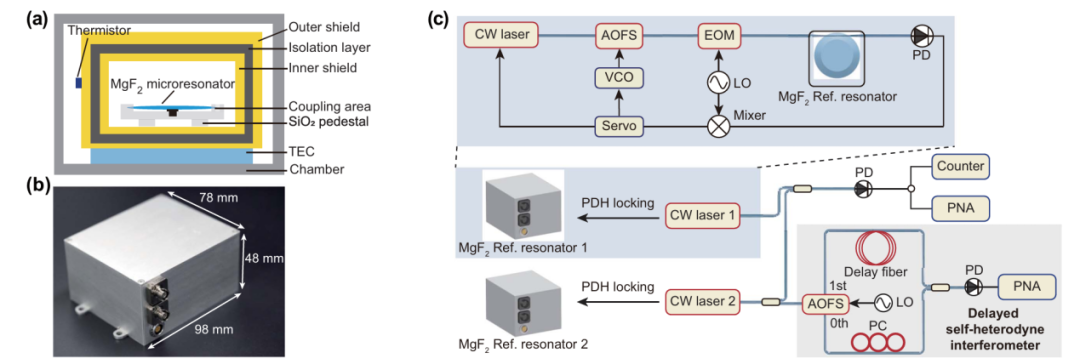
Figure 1. Package structure and experimental system. (a) Schematic diagram of the package structure; (b) Photograph of the packaged device; (c) Experimental setup for laser frequency stabilization and performance characterization.
The research team selected a single-crystal MgF₂ with low absorption and a low thermal expansion coefficient, and fabricated a disc-shaped microcavity approximately 30 mm in diameter through precision mechanical grinding and polishing, achieving a loaded quality factor as high as 2.24 × 10⁶. This reference cavity module employs polarization-maintaining fiber taper coupling and a compact package (48 mm × 78 mm × 98 mm), with an integrated temperature-control system that eliminates the need for vacuum encapsulation or active vibration isolation, enabling stable operation under non‑laboratory conditions. By employing Pound–Drever–Hall (PDH) frequency stabilization, a commercial fiber laser was locked to this MgF₂ whispering-gallery-mode microcavity reference, yielding a measured integrated linewidth of 4 Hz (Definition of 1 rad²), the fractional frequency stability at an integration time of 10 ms is 2.5×10⁻¹⁰ @ 10 ms , approaching the theoretical limit of thermal‑shot noise, a hertz‑level integrated linewidth has been achieved at room temperature using a compact solid‑state reference cavity.
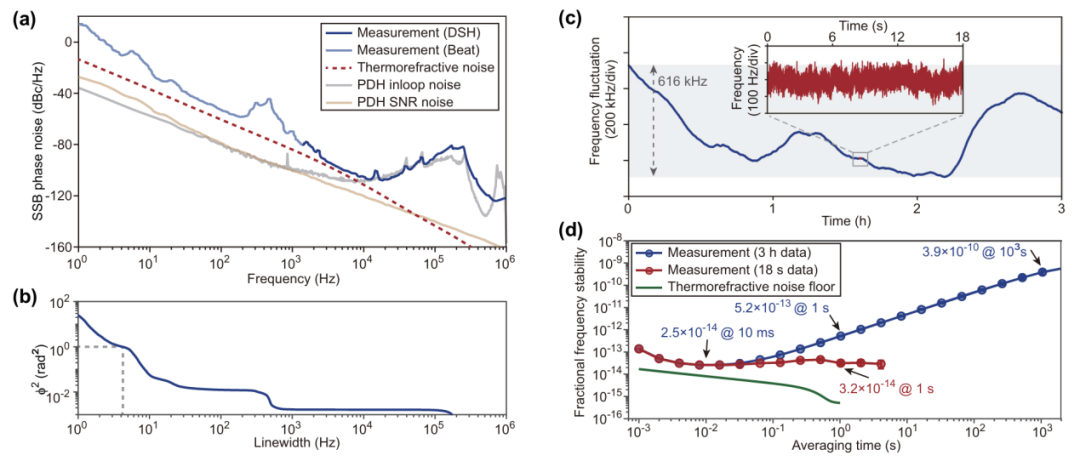
Figure 2. Frequency‑stabilized laser performance. (a) Phase noise measurements and simulation results; (b) Integrated phase noise yielding a 4 Hz integrated linewidth; (c) Time‑domain beat signal of two independent frequency‑stabilized lasers; (d) Frequency stability of the laser system.
The innovative significance of this work lies in compressing the core components of an ultra‑stable laser—traditionally requiring a large laboratory environment—down to palm‑sized dimensions, while enabling operation entirely at ambient temperature and pressure, without the need for vacuum or active vibration isolation, and with exceptionally high robustness. This technology provides a critical device foundation for applications such as portable optical atomic clocks, high‑precision navigation, geodesy, remote sensing, and miniaturized microwave photonic oscillators, holding the promise of translating laboratory‑grade precision measurement capabilities into deployable field‑ready systems.
Co-corresponding author 、 Researcher Zhang Fangxing, Yangtze River Delta Institute of Optoelectronic Science, Peking University indicate “In the past, we always believed that linewidths on the order of hertz could only be achieved using ultra‑stable Fabry–Perot cavities coupled with vacuum systems; now, a compact, room‑temperature package no larger than the palm of your hand can deliver the same performance. This opens up entirely new possibilities for bringing systems such as atomic clocks and precision sensing devices—both of which rely on frequency‑stabilized lasers—into real‑world field experiments.”
The research team plans to further optimize the microcavity’s cross-section to increase the mode volume, or adopt a sandwich‑type composite structure to compensate for thermal expansion, with the aim of improving frequency stability to the 10⁻¹⁹ level and achieving an integrated linewidth approaching the sub‑hertz regime. Meanwhile, by leveraging the broad transparency window of MgF₂, they will extend the operating wavelength into the near‑visible spectral region and explore hybrid integration with photonic integrated chips, thereby advancing the development of all‑solid‑state, portable optical atomic clocks.
Written by | Zhang Fangxing, Yangtze River Delta Institute of Optoelectronic Science, Peking University
LATEST NEWS
Thank you for visiting the official website of Chongfan Technology. If you have cooperation intentions or suggestions, please contact us through the following methods, and we will reply as soon as possible, thank you!
Address: Room 403, Building 6, Phase III of R&D, No. 36 Xiyong Avenue, High tech Zone, Chongqing, China.
Telephone: +86-13658337211
E-mail: Sales@cfkeji.net
Website: www.cfkeji.net
Mobile Version