
Chongfan Technology
News
20
2026
-
04
The Shanghai Institute of Optics and Fine Mechanics Has Achieved a Significant Breakthrough in Laser Welding of Dissimilar Alloys: Titanium Alloys and Nickel-Based Superalloys
Author:
High-quality joining of dissimilar materials is a core and challenging process in high-end manufacturing sectors such as aerospace, new-energy vehicles, and electronic packaging. Recently, a research team led by Researcher Shanglu Yang from the Department of Advanced Optoelectronic Equipment at the Shanghai Institute of Optics and Fine Mechanics, Chinese Academy of Sciences, has achieved a significant breakthrough in laser welding of titanium alloys and nickel-based superalloys. Addressing the longstanding issues associated with conventional Ti/Ni dissimilar joints—namely the facile formation of brittle intermetallic compounds, complex interfacial microstructures, and limited joint strength—the team has developed a novel laser welding method based on precise control of ultra-fine laser spot energy. This approach enables interfacial microstructure reconfiguration, thereby substantially enhancing the mechanical properties of Ti-6Al-4V/Inconel 718 dissimilar joints. The relevant research findings have been published in the Journal of Materials Processing Technology under the title “Interfacial Microstructure Reconfiguration for High-Strength Ti-6Al-4V/Inconel 718 Dissimilar Joints via Ultra-Fine Laser Beam Welding.”
Ti-6Al-4V titanium alloy boasts high specific strength and excellent corrosion resistance, while Inconel 718 nickel-based superalloy offers outstanding high-temperature strength and thermal stability; both hold significant application potential in aerospace, marine engineering, power generation, and other fields. Achieving high-quality joining of these two materials enables simultaneous realization of lightweight design and superior high-temperature service performance within a single component, thereby delivering substantial value in high-end equipment such as aerospace systems. However, due to the poor metallurgical compatibility between titanium alloys and nickel-based superalloys, direct welding readily leads to the formation of large quantities of brittle intermetallic compounds, resulting in insufficient joint toughness and limited load-carrying capacity. Although existing laser welding techniques can mitigate interfacial reactions to some extent, they still commonly suffer from non-uniform microstructures at the interface, difficulty in effectively suppressing brittle phases, and limited joint strength.
To address the aforementioned challenges, the research team employed a single-mode ultrafine laser beam in conjunction with a single-layer Cu interlayer for welding, and achieved interface microstructure optimization by carefully controlling the heat input. The study revealed that the ultrafine spot size effectively increases the cooling rate, reduces the extent of base-metal melting, and suppresses the diffusion of elements such as Ni, Fe, and Cr toward the Ti/Cu interface, thereby facilitating the transformation of the Ti-side transition layer from a non-uniform, bilayer brittle structure to a Ti–Cu gradient structure. This gradient structure exhibits a more continuous distribution of composition and hardness, which helps mitigate abrupt changes in interfacial properties and enhances the load-carrying capacity of the joint.
Further studies have demonstrated that the optimized interface microstructure can effectively alter the crack propagation path, thereby enhancing the joint’s fracture resistance and overall mechanical performance. Mechanical testing results show that, following ultra-fine spot welding, the tensile strength of the joint increases substantially from 260 MPa under conventional processing to 538.8 MPa, significantly outperforming the reported properties of conventional Ti/Ni dissimilar laser-welded joints.
This study offers a new technological approach for the highly reliable laser joining of dissimilar materials such as Ti-6Al-4V and Inconel 718. Researcher Shanglu Yang from the Shanghai Institute of Optics and Fine Mechanics, Chinese Academy of Sciences, serves as the corresponding author of the paper, with Ph.D. student Qian’an Yin as the first author. This research was supported by the Shanghai Natural Science Foundation.
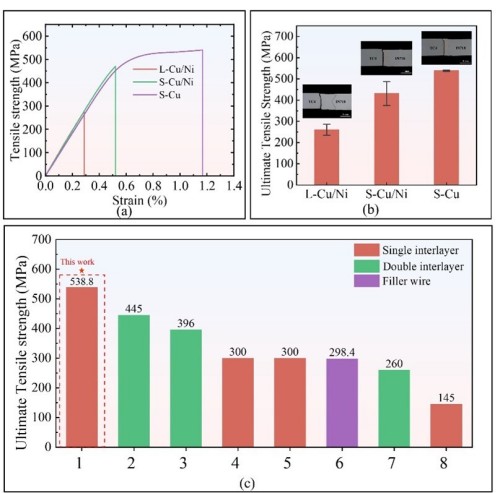
Figure 1 Tensile test results of the joint: (a) Engineering stress–strain curve of the specimen; (b) Ultimate tensile strength of the specimen; (c) Comparison of the tensile strength in this study with reported literature values.
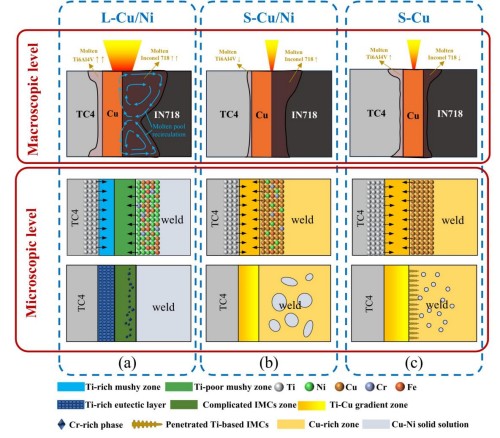
Figure 2 Schematic diagram of base metal melting, elemental diffusion at the Ti/weld interface, and microstructural evolution within the transition zone.
Source: Shanghai Institute of Optics and Fine Mechanics
LATEST NEWS
Thank you for visiting the official website of Chongfan Technology. If you have cooperation intentions or suggestions, please contact us through the following methods, and we will reply as soon as possible, thank you!
Address: Room 403, Building 6, Phase III of R&D, No. 36 Xiyong Avenue, High tech Zone, Chongqing, China.
Telephone: +86-13658337211
E-mail: Sales@cfkeji.net
Website: www.cfkeji.net
Mobile Version