
Chongfan Technology
News
01
2026
-
04
Shanghai Institute of Optics and Fine Mechanics Achieves New Progress in Gallium Oxide Crystal Growth
Author:
Recently, a team led by Qi Hongji and Jia Ning at the Laser Crystal Center of the Shanghai Institute of Optics and Fine Mechanics, Chinese Academy of Sciences, in collaboration with the Hangzhou Institute of Optics and Fine Mechanics, has achieved new breakthroughs in the growth of gallium oxide crystals. The relevant research findings have been published in CrystEngComm under the title “Realization of 4-Inch and Thick β-Ga2O3 Single Crystals Using the Vertical Bridgman Method.”
Gallium oxide, as a representative material for ultra-wide-bandgap semiconductors in the post-Moore era, boasts a wide bandgap, high breakdown electric field strength, and low cost, making it highly promising for applications in new-energy vehicles, data centers, smart grids, and other fields. The controllable synthesis of high-quality, large-size gallium-oxide single crystals has thus become a major research focus in both the international academic community and industry. The vertical Bridgman (VB) method offers a crucial technological route for low-cost, iridium-free growth of gallium-oxide crystals and is among the most competitive approaches for preparing such single crystals. Nevertheless, during the growth of large-size crystals, significant challenges remain in areas such as thermal-field stability control, defect engineering, and achieving uniform crystal quality.
To address the aforementioned key challenges, the research team employed the vertical Bridgman (VB) method in conjunction with thermal-field simulation to systematically control the morphology of the crystal growth interface and the distribution of the temperature gradient, thereby achieving, for the first time internationally, the fabrication of an 8-inch gallium oxide single crystal (https://mp.weixin.qq.com/s/Wo11YjCB2bjQvAQm88XavQ). In a paper published in CrystEngComm (2026, DOI: 10.1039/D5CE01023C), the researchers conducted a comprehensive characterization of the properties of a 4-inch-diameter, more than 30 mm-thick (100)-oriented gallium oxide crystal grown by the VB method. The test results showed that the wafer’s high-resolution X-ray diffraction (HRXRD) full width at half maximum (FWHM) ranged from 49.6 to 64.8 arcseconds, indicating high crystalline quality and excellent structural uniformity. These findings provide critical technical support for the scalable production of high-quality, large-size gallium oxide single crystals.
Currently, the team is collaborating with Fudan University, Xi’an University of Electronic Science and Technology, Shanghai Gongcheng Semiconductor, and other institutions to conduct materials–device co-optimization and validation tailored to device-level application requirements. This effort aims to accelerate the iterative performance enhancement of gallium oxide materials and the demonstration deployment of power devices, thereby continuously strengthening our capability for independent and controllable material supply.
In addition, the team has actively spearheaded the establishment of China’s first Strategic Alliance for Technological Innovation in the Ultra-Wide Bandgap Semiconductor Industry and is vigorously contributing to the development of the Shanghai Ultra-Wide Bandgap Semiconductor Future Industrial Cluster. These efforts are helping to foster deep integration between the gallium oxide innovation chain and the industrial value chain, thereby providing robust support for Shanghai’s accelerated development of a new growth driver in the fourth-generation semiconductor industry.
This research has been supported by projects such as the Key R&D Program of the Ministry of Science and Technology, the Shanghai Municipal Strategic Frontier Special Project, the Shanghai Natural Science Foundation, and the Chinese Academy of Sciences’ Pioneer Initiative.
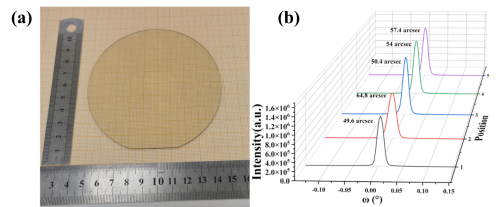
Figure 1 (a) Image of a 4-inch gallium oxide wafer, (b) High-resolution XRD rocking curve of the gallium oxide wafer
Source: Shanghai Institute of Optics and Fine Mechanics
LATEST NEWS
Thank you for visiting the official website of Chongfan Technology. If you have cooperation intentions or suggestions, please contact us through the following methods, and we will reply as soon as possible, thank you!
Address: Room 403, Building 6, Phase III of R&D, No. 36 Xiyong Avenue, High tech Zone, Chongqing, China.
Telephone: +86-13658337211
E-mail: Sales@cfkeji.net
Website: www.cfkeji.net
Mobile Version