
Chongfan Technology
News
01
2026
-
04
Study Reveals the White-Light Emission Mechanism in Two-Dimensional Halide Perovskites
Author:
Two-dimensional halide perovskites are ideal candidate materials for high-efficiency light-emitting devices. Among them, two-dimensional lead bromide perovskites have attracted increasing attention due to their broad-band white-light emission and high photoluminescence quantum yield.
Recently, the National Center for Nanoscience and Technology of the Chinese Academy of Sciences has achieved a breakthrough in research on the white-light emission mechanism of two-dimensional halide perovskites, systematically elucidating the intrinsic link between structural distortion and self-trapped exciton luminescence. This work provides crucial theoretical support and technical guidance for the materials design and performance optimization of next-generation white-light light-emitting diodes.
The research team innovatively selected a series of two-dimensional lead bromide perovskites featuring the same structural motif but varying ring sizes of cyclic organic cations as their study subjects. By precisely tuning the steric hindrance effects of the organic cations, they systematically investigated the impact of structural distortions on luminescent properties.
The study found that, as the size of the cyclic organic cation ring increases, the emission intensity of self-trapped excitons rises markedly due to the enhanced electron–phonon coupling. These findings provide new insights into the correlation between structural distortions and the emission properties of self-trapped excitons, and are of significant value in guiding the design and optimization of perovskite-based single-emitter white-light-emitting diodes.
The relevant research findings have been published in Nature Communications. This research was supported by the National Key R&D Program, the National Outstanding Youth Science Fund, the National Natural Science Foundation of China, and other funding sources.
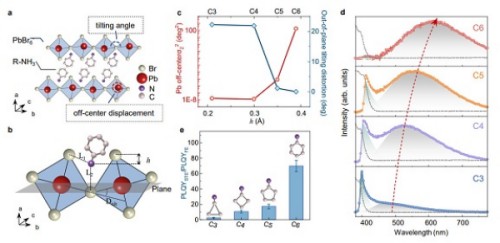
Cyclic Organic Cation–Dependent Self-Trapped Exciton Emission in Two-Dimensional Halide Perovskites
Source: National Center for Nanoscience and Technology
LATEST NEWS
Thank you for visiting the official website of Chongfan Technology. If you have cooperation intentions or suggestions, please contact us through the following methods, and we will reply as soon as possible, thank you!
Address: Room 403, Building 6, Phase III of R&D, No. 36 Xiyong Avenue, High tech Zone, Chongqing, China.
Telephone: +86-13658337211
E-mail: Sales@cfkeji.net
Website: www.cfkeji.net
Mobile Version