
Chongfan Technology
News
30
2026
-
03
Progress Achieved in Research on Optically Injected Locking of Terahertz Semiconductor Lasers
Author:
Recently, a research team from the Shanghai Institute of Microsystem and Information Technology of the Chinese Academy of Sciences has made progress in the field of optical injection locking of terahertz quantum-cascade lasers. The team has proposed an optical mutual-injection (MOI) locking scheme between a terahertz single-mode quantum-cascade laser and a frequency-comb quantum-cascade laser. This scheme achieves frequency synchronization solely through optical coupling, without the need for external locking hardware such as phase-locked loops or microwave injection devices.
The research team has, for the first time experimentally, achieved optical mutual injection locking between a terahertz-band single-mode quantum cascade laser and a frequency-comb quantum cascade laser. The two quantum cascade lasers are fabricated on the same epitaxial wafer and mounted face-to-face on a Y-shaped cold finger, enabling bidirectional optical coupling. In the experiments, by adjusting the current bias, the team can tune the operating states of the single-mode quantum cascade laser and the frequency-comb quantum cascade laser, control their frequency difference, and thereby switch the system from an unlocked state to a locked state. In the unlocked state, the two lasers exhibit weak coupling, resulting in beat notes between the single-mode laser and the teeth of the frequency comb and generating a series of radio-frequency signals (fbn). Under MOI locking, the single-mode quantum cascade laser is aligned with the frequency-comb tooth closest to it, causing the fbn signals to disappear and leaving only stable intermodal beat signals (frep and its harmonics); the locking bandwidth is denoted by Δflock.
Experimental results demonstrate that by tuning the frequency detuning between two quantum cascade lasers, the MOI locking phenomenon can be clearly observed, and this phenomenon exhibits pronounced asymmetry depending on the master–slave laser configuration: when a single-mode quantum cascade laser serves as the master laser, the optical frequency comb displays perturbative effects such as repetition-rate shifts, linewidth broadening, and locking, with a maximum locking bandwidth of approximately 30 MHz; in contrast, when the optical-frequency-comb quantum cascade laser is used as the master laser, the instability region is suppressed, and the locking bandwidth expands to 94 MHz. Within the locked regime, both the phase noise of the repetition rate and the Allan variance are significantly improved, indicating that the stability of the optical frequency comb is effectively enhanced. This compact MOI locking scheme lays the foundation for the stable operation of chip-scale terahertz optical frequency combs and their applications in optical frequency division. The relevant research findings have been published in APL Photonics. This work was supported by the National Natural Science Foundation of China, the Ministry of Science and Technology, and the Chinese Academy of Sciences.
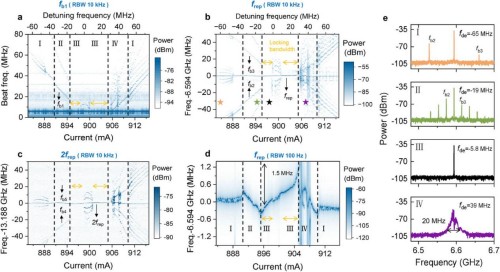
Experimental measurement results of optical mutual injection between a single-mode terahertz quantum cascade laser and a frequency-comb terahertz quantum cascade laser, with the single-mode quantum cascade laser serving as the master laser.
Source: Shanghai Institute of Microsystem and Information Technology
LATEST NEWS
Thank you for visiting the official website of Chongfan Technology. If you have cooperation intentions or suggestions, please contact us through the following methods, and we will reply as soon as possible, thank you!
Address: Room 403, Building 6, Phase III of R&D, No. 36 Xiyong Avenue, High tech Zone, Chongqing, China.
Telephone: +86-13658337211
E-mail: Sales@cfkeji.net
Website: www.cfkeji.net
Mobile Version