
Chongfan Technology
News
06
2026
-
03
A new type of “flat-top” surgical laser
Author:
Laser cutting is considered an ideal tool for surgical procedures due to its precision and non-contact nature. However, in hard tissues such as bone, it has long been plagued by slow cutting speeds and insufficient cutting depth. Now, a research team from the University of Basel in Switzerland has developed a new type of “flat-top” surgical laser that enables deeper and faster bone tissue cutting than ever before, opening up more possibilities for laser applications in orthopedic surgery. The relevant findings have been published in the latest issue of the journal *Scientific Reports*.
The research team found that the key factor limiting the depth of laser cutting lies in the uneven distribution of energy within the laser beam. A conventional Gaussian beam is strongest at its center and gradually weakens toward the edges—much like the beam from a flashlight. As the cutting depth increases, the sidewalls of the cut absorb a significant amount of energy, leaving insufficient energy at the bottom of the cut and thereby restricting the maximum cutting depth.
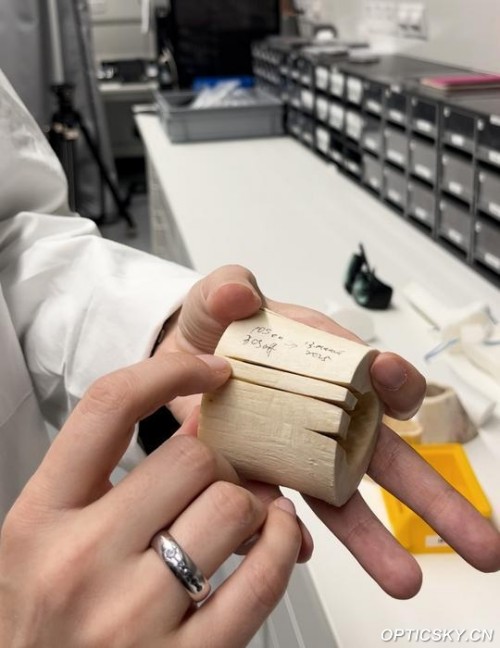
Researchers demonstrated the cutting depth that can be achieved by adjusting the energy distribution of the laser beam.
To address this issue, researchers have developed a “flat-top” laser beam: the beam’s energy is evenly distributed at its center and drops off rapidly toward the edges, ensuring a more uniform distribution of laser energy across the cutting area and improving the efficiency of deep-cutting operations. Ph.D. student Liu Mingyi stated, “With a more uniform energy distribution, laser cutting efficiency is higher and the cutting speed is faster.”
In the experiment, the team compared two types of laser beams on bovine bone samples and used compressed air and water cooling to prevent thermal damage. The results showed that the conventional Gaussian beam achieved a cutting depth of approximately 2.6 centimeters, whereas the “flat-top” laser beam reached a depth of 4.4 centimeters—nearly matching the ideal depth of 4.5 centimeters. The researchers noted that this design enables the laser to maintain high efficiency even at greater depths.
Despite advances in cutting depth, laser speeds still lag behind those of mechanical tools. Currently, a “laser blade” can remove only about 0.4 cubic millimeters of bone tissue per second, whereas a mechanical saw can remove up to 11 cubic millimeters. However, this breakthrough is the first to bring laser cutting depths close to clinical requirements.
Laser cutting does not apply mechanical pressure, which reduces the risk of microcracks and enables extremely precise cutting operations. In the future, this technology is expected to be combined with customized 3D-printed joint prostheses, offering more accurate solutions for complex orthopedic surgeries.
Source: Guangxing Tianxia
LATEST NEWS
Thank you for visiting the official website of Chongfan Technology. If you have cooperation intentions or suggestions, please contact us through the following methods, and we will reply as soon as possible, thank you!
Address: Room 403, Building 6, Phase III of R&D, No. 36 Xiyong Avenue, High tech Zone, Chongqing, China.
Telephone: +86-13658337211
E-mail: Sales@cfkeji.net
Website: www.cfkeji.net
Mobile Version