
Chongfan Technology
News
20
2026
-
11
Scientists have used topological probes to achieve, for the first time, atomic-scale spin imaging of interdigitated magnets.
Author:
Recently, teams including the University of Science and Technology of China have fabricated a class of quantum spin Hall insulators into scanning tunneling microscopy probes, developing a new method for spin detection at the atomic scale. Leveraging this technology, the researchers achieved spin-resolved real-space imaging, quasiparticle interference imaging, and magnetic-field response spectroscopy, providing direct experimental evidence for two-dimensional d-wave staggered magnetic order.
Probing spin electronic states at the atomic scale is a crucial tool for studying emergent phenomena in quantum materials. Conventional magnetic spin-resolved probes are prone to interference at their tips and rely on external magnetic fields. By employing focused ion beam microfabrication, the team fabricated α‑phase bismuth bromide single crystals into scanning tunneling microscope tips with atomic resolution. Spectroscopic calibration confirms that the processed tip retains the characteristic helical boundary states.
Experimental verification shows that the probe exhibits spin selectivity; leveraging the spin–momentum locking of helical edge states, it can selectively access different spin-polarized electronic states by controlling the direction of the tunneling current.
The team used this new method to study potassium vanadium selenium oxide, a candidate material for intercalated magnets. Relying on atomic imaging, they resolved the positions of two mirror-symmetric vanadium atoms and observed a distinctive lattice structure formed by density waves. By comparing conductance maps at different voltages, they obtained real-space images consistent with a checkerboard antiferromagnetic arrangement. The study also found that quasiparticle excitations and interference patterns along the two orthogonal crystal axes exhibit opposite spin polarizations, providing direct experimental evidence for spin splitting in d-wave symmetry.
The team integrated the results of various experiments and, combined with theoretical analysis, confirmed that all findings support the existence of two-dimensional d-wave staggered magnetic order in the potassium–vanadium–selenium–oxygen surface layer.
This work demonstrates the potential of topological quantum materials as probes for measuring quantum states. The method holds promise for applications in two-dimensional magnets and moiré materials, offering a new technique for studying spin properties at the atomic scale.
The relevant research findings were published in Nature.
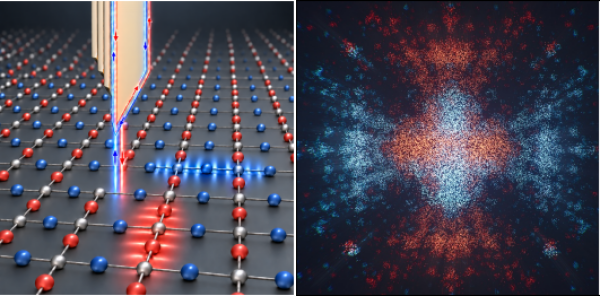
Schematic diagram: Working principle of the helical edge-state probe (left); electron scattering characteristics of a d-wave staggered magnetic field (right)
Source: University of Science and Technology of China
Previous
Previous
LATEST NEWS
Thank you for visiting the official website of Chongfan Technology. If you have cooperation intentions or suggestions, please contact us through the following methods, and we will reply as soon as possible, thank you!
Address: Room 403, Building 6, Phase III of R&D, No. 36 Xiyong Avenue, High tech Zone, Chongqing, China.
Telephone: +86-13658337211
E-mail: Sales@cfkeji.net
Website: www.cfkeji.net
Mobile Version
