
Chongfan Technology
News
26
2026
-
10
The Anhui Institute of Optics and Fine Mechanics has achieved synergistic co‑inversion of multiple aerosol parameters using polarization measurements and enabled model transfer across satellite platforms.
Author:
The Optical Remote Sensing Center team at the Anhui Institute of Optics and Fine Mechanics, Chinese Academy of Sciences, has developed a physics‑guided cascaded deep learning aerosol retrieval method (PCDL‑AER), leveraging the high‑precision polarization scanner (POSP) — a polarization payload developed by the institute and carried aboard the Gaofen‑5 (02) satellite (GF‑5(02)) and the DQ‑1 satellite. This approach enables optically consistent, multi‑parameter aerosol retrieval and facilitates model transfer across different satellites.
The relevant findings, titled “Optically consistent multi-parameter aerosol retrieval from dual-satellite polarimetric observations enabled by physics-guided deep learning,” were published in Remote Sensing of Environment, a leading journal in the field of remote sensing.
Atmospheric aerosols are tiny particulate matter suspended in the atmosphere; their particle size and optical absorption and scattering properties directly influence Earth’s radiative budget and the environment. Spaceborne polarization observations can provide critical information on the optical–microphysical characteristics of aerosols, creating favorable conditions for multi‑parameter aerosol retrieval. A key challenge in advancing polarization remote sensing toward operational applications is how to fully leverage polarization and radiometric data to efficiently retrieve aerosol concentrations, particle sizes, and absorption coefficients, while ensuring that a single retrieval approach remains consistent across different satellite platforms. Artificial intelligence offers new avenues for efficient inversion, but aligning inversion results with the physical relationships among aerosol parameters and enabling model transferability across satellites remain pressing issues that must be addressed to support the product‑level utilization of long‑term global observational datasets.
To address the aforementioned requirements, the team has developed a hierarchical modeling framework that progresses stepwise from “aerosol content” to “inversion of particle size and absorption properties.” This framework integrates polarization and radiative observation data while incorporating the physical relationships among aerosol parameters into the learning process. First, it retrieves multi-wavelength aerosol optical depth (AOD) and derives the Ångström exponent (AE). Building on these upstream results as priors, it jointly inverts fine- and coarse-mode optical depths (AODF and AODC), as well as absorption and scattering optical depths (AAOD and SAOD), and further computes the fine-mode fraction (FMF) and single-scattering albedo (SSA). This approach enables the simultaneous characterization of aerosol content, particle-size distribution, and absorption properties, while enhancing the optical consistency of the multi-parameter estimates.
To validate the model’s cross-satellite transferability, the team trained the model using GF‑5 (02) and POSP observations and applied it directly to DQ‑1/POSP data without any further retraining. Compared with AERONET ground-based products, the multi‑band AOD showed excellent overall agreement, with correlation coefficients ranging from 0.89 to 0.95. The coarse‑ and fine‑mode AODs, as well as the FMF, also exhibited good consistency; after excluding samples with AODs below 0.1, the FMF achieved a correlation coefficient of 0.77. For absorption properties, using AERONET Level 2.0 retrieval products as the reference, the multi‑band AAOD correlations were 0.74–0.84, and for each band, 68%–83% of the validation samples had absolute errors in SSA no greater than 0.03. These results demonstrate that, even after cross‑satellite transfer, the model retains strong capabilities for the simultaneous retrieval of multiple parameters, thereby supporting the generation of products from similar polarization‑based sensors on different satellite platforms.
Building on this foundation, the team at the Anhui Institute of Optics and Fine Mechanics has developed a global land‑based aerosol multi‑parameter product suite spanning 2021–2025, encompassing both single‑satellite and dual‑satellite fusion products, with ongoing updates. This series of products effectively fills the data gap that emerged after the POLDER/PARASOL mission concluded, providing critical temporal continuity with next‑generation polarimetric satellite observations such as PACE and 3MI. It offers essential data support for studying long‑term trends in aerosol particle size and absorption properties, as well as for inter‑mission product comparisons, thereby highlighting the unique value of domestically developed polarimetric payloads in enhancing the global long‑term aerosol observation record.
This work was supported by the National Key R&D Program. Wang Zhihui, a doctoral student at the Anhui Institute of Optics and Fine Mechanics, is the first author of the paper, and Researcher Chen Cheng is the corresponding author.
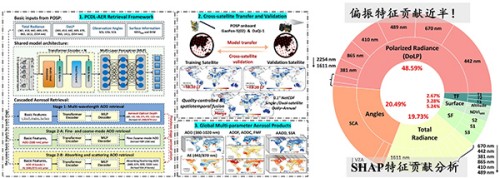
POSP-PCDL-AER Global Aerosol Multi-Parameter Retrieval
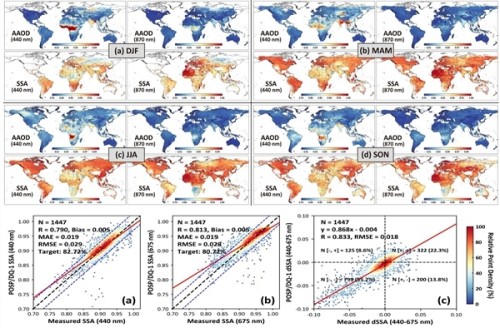
Spatial Distribution and Accuracy Verification of Global Aerosol Properties
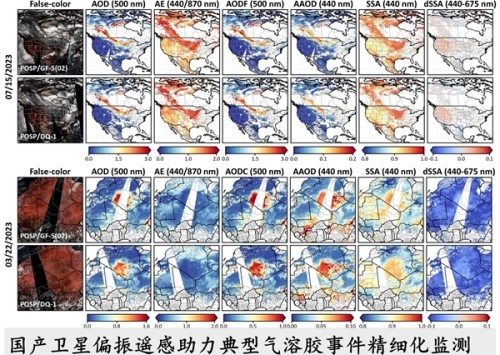
Case Study Demonstration of Wildfire Plumes and Dust Aerosols
Source: Anhui Institute of Optics and Fine Mechanics
Thank you for visiting the official website of Chongfan Technology. If you have cooperation intentions or suggestions, please contact us through the following methods, and we will reply as soon as possible, thank you!
Address: Room 403, Building 6, Phase III of R&D, No. 36 Xiyong Avenue, High tech Zone, Chongqing, China.
Telephone: +86-13658337211
E-mail: Sales@cfkeji.net
Website: www.cfkeji.net
Mobile Version
