
Chongfan Technology
News
26
2026
-
10
The Dalian Institute of Chemical Physics has used the Dalian Coherent Light Source to discover the smallest encapsulated water cage.
Author:
Recently, the Cluster Spectroscopy and Dynamics Research Group (Group 2506) at the State Key Laboratory of Chemical Reaction Dynamics, Dalian Institute of Chemical Physics, in collaboration with the theoretical team led by Academician Jun Li of Tsinghua University, used a self-developed infrared spectroscopy station for neutral clusters based on the Dalian Coherent Light Source. Their experiments revealed that the smallest water‑enclosed cage consists of 17 water molecules, providing new scientific evidence for elucidating the structural evolution mechanisms of water.
Hydrogen bonds between water molecules are constantly breaking and reforming, making water one of the most complex systems in the condensed phase. The journal Science has listed “What is the structure of water?” among the 125 most challenging scientific questions of this century. The microscopic configuration of liquid water is difficult to capture, and its structural characterization has long posed significant challenges. The geometric structures of clusters often provide clues to the structural principles of bulk matter; by precisely controlling the number of constituent molecules, cluster science offers a high‑resolution window into the stepwise evolution of hydrogen‑bond networks. However, neutral species, lacking charge, are hard to detect and mass‑select, which has for decades constrained precision spectroscopic studies of neutral water clusters due to technical bottlenecks in size selection.
To achieve precise detection and structural analysis of neutral water clusters, Jiang Ling and Li Gang’s research team independently developed an infrared spectroscopy experimental method based on the Dalian Coherent Light Source, enabling highly sensitive infrared spectroscopic probing, structural characterization, and performance studies of mass-selected neutral clusters in the gas phase (J. Phys. Chem. Lett., 2020). Building on this approach, the team has carried out infrared spectroscopic investigations of water dimers through undecamers (H2O)n (n = 2–11) (Proc. Natl. Acad. Sci., 2020; Nat. Commun., 2020; Cell Rep. Phys. Sci., 2022; J. Chem. Phys., 2023; J. Phys. Chem. Lett., 2024; Nat. Commun., 2025), uncovering a series of novel structures: they have determined the three-dimensional geometry of the smallest water droplet composed of five molecules, elucidated the “3+3” structure of the hexamer, the “4+4” arrangement of the octamer, and the “5+5” motif of the decamer, as well as three distinct structural models for the undecamer—“5+1+5,” “4+3+4,” and “5+5+1.” These findings demonstrate that the stacking patterns of small-sized water rings play a crucial role in the construction of water’s hydrogen-bonding network.
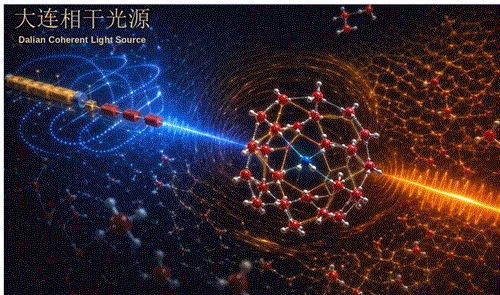
“How many water molecules are required to form the smallest encapsulating cage structure around a single water molecule” is an important question closely related to liquid water, hydrophobic solvation, and ice nucleation, yet it remains unresolved. Recently, the teams of Jiang Ling and Li Gang, using the neutral cluster experimental station based on the Dalian Coherent Light Source, measured the infrared spectrum of the neutral water‑molecule heptadecamer cluster (H₂O)₁₇. Combined with high‑precision quantum chemical calculations from Li Jun’s group, they identified three lowest‑energy structural models—namely, the encapsulated water cage, the fused pentagonal prism, and the fused cube—with the encapsulated water cage being the dominant configuration. This work demonstrates that (H₂O)₁₇ constitutes the smallest cage enclosing a single water molecule, providing crucial insights into the hydrogen‑bonding network of the first coordination shell in liquid water. Notably, the oxygen‑atom framework of this cage forms a novel nonclassical polyhedron, featuring four quadrilateral faces, four pentagonal faces, and two hexagonal faces—distinct from traditional Platonic, Archimedean, and Johnson solids—and offers new perspectives on whether conventional geometric constraints are sufficient to describe the structures that hydrogen‑bonded systems can adopt.
The relevant research findings, titled “Smallest Endohedral Water Cage Featuring a Nonclassic Polyhedron: Experimental Observation of (H2O)17,” were recently published in the Journal of the American Chemical Society. The co-first authors of this work are Yan Wenhui, a Ph.D. student in Group 2506 of our institute, and Associate Researcher Zhang Yangyang from the Ganjiang Innovation Institute of the Chinese Academy of Sciences. This research was supported by the National Natural Science Foundation of China, the National Natural Science Foundation’s Basic Science Center project on “Frontier Research in Dynamic Chemistry,” the Ministry of Science and Technology’s Major Project under the “Science and Technology Innovation 2030” initiative, and the Chinese Academy of Sciences’ Category B Pilot Program on “Precise Probing of Chemical Reaction Transition States Based on Extreme Ultraviolet Light Sources,” among other funding sources.
Source: Dalian Institute of Chemical Physics
Thank you for visiting the official website of Chongfan Technology. If you have cooperation intentions or suggestions, please contact us through the following methods, and we will reply as soon as possible, thank you!
Address: Room 403, Building 6, Phase III of R&D, No. 36 Xiyong Avenue, High tech Zone, Chongqing, China.
Telephone: +86-13658337211
E-mail: Sales@cfkeji.net
Website: www.cfkeji.net
Mobile Version
