
Chongfan Technology
News
26
2026
-
10
An Guang has made progress in research on hyperspectral digital imaging and generation technologies.
Author:
Recently, the remote-sensing information characterization research team at the Anhui Institute of Optics and Fine Mechanics has conducted research on multispectral digital imaging and synthesis technologies, achieving progress in areas such as near-infrared image colorization, shortwave infrared multi-band color reconstruction, and visible-to-thermal infrared image generation. Relevant findings have been published in the optics and remote-sensing journals Remote Sensing and Applied Optics.
Multispectral remote-sensing imaging can acquire radiometric information of targets and the environment across different spectral bands, finding broad applications in environmental monitoring, target recognition, and perception of complex scenes. However, the imaging mechanisms and image characteristics vary significantly among spectral bands: near-infrared and shortwave infrared images typically lack natural color information, while thermal infrared imagery is influenced by scene temperature, material emissivity, and environmental conditions, making data acquisition and scene simulation relatively complex. To address these challenges, the research team integrated spectral‑physical analysis with deep learning techniques to develop methods for cross‑spectral image reconstruction and digital generation.
In the field of near-infrared image colorization, the team proposed the RWU‑DD‑GAN method, which is based on conditional generative adversarial networks. By incorporating wavelet convolution, a residual architecture, and a channel attention mechanism, the approach enhances multi-scale feature extraction and employs a dual‑scale discriminator to simultaneously preserve both the overall scene structure and local details. Experimental results demonstrate that this method effectively mitigates color distortion and texture blurring in near-infrared image color reconstruction, delivering superior reconstruction performance across diverse scenes while maintaining real-time processing capabilities.
Building on this foundation, the team further pursued research on multispectral color reconstruction in the shortwave infrared. Addressing challenges such as insufficient information in single‑band shortwave infrared imagery and the phenomenon of spectral similarity with distinct colors across different land cover types, they proposed a band‑optimization approach that integrates physical analysis with data‑driven methods. By jointly accounting for atmospheric transmittance, the spectral reflectance characteristics of surface materials, and band‑information redundancy, they selected an optimal three‑band combination in the shortwave infrared and employed a Pix2Pix network to achieve color reconstruction of shortwave infrared images. Compared with a single‑band U‑Net baseline, this method improved the peak signal‑to‑noise ratio by 8.63%, increased structural similarity by 18.87%, and reduced the perceptual loss index LPIPS by 31.28%.
Addressing the challenges posed by substantial differences in the imaging mechanisms of visible and thermal infrared imagery, as well as the scarcity of paired training data, the team has proposed the Dual‑Geometric Cycle Generative Adversarial Network (DGC_GAN). This method integrates geometric consistency with cycle‑consistency constraints, separating image semantic structure from imaging style to enable cross‑modality image synthesis from visible to thermal infrared under unpaired conditions, while supporting diverse generation within the same scene. Experiments on multiple public datasets demonstrate that the proposed approach achieves strong performance in both the realism and diversity of generated images. Furthermore, the research team collected real‑world data using a UAV‑borne dual‑spectral imaging platform, validating the method’s feasibility for applications in complex land‑cover scenarios.
The aforementioned research, centered on information representation in remote-sensing imagery across different spectral bands and on cross-spectral transformation, has yielded a series of findings spanning image feature extraction, spectral-band optimization, and cross-spectral-domain image generation. These advances provide technical support for expanding infrared remote-sensing datasets, simulating images of complex scenes, and advancing related algorithmic studies. Moving forward, the team will further explore the integration of radiative-transfer physical models with generative artificial-intelligence approaches, aiming to enhance the radiometric consistency of cross-spectral images and their capacity for quantitative applications.
The first authors of the relevant research paper are, respectively, Ph.D. student Yao Shun and Master’s student Chen Qidong, while the corresponding author is Associate Researcher Liu Xiao from the Anhui Institute of Optics and Fine Mechanics.
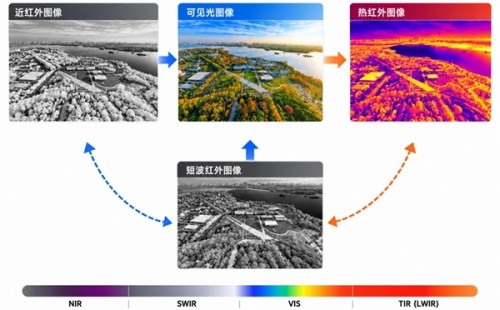
Schematic diagram of multispectral digital imaging and generation
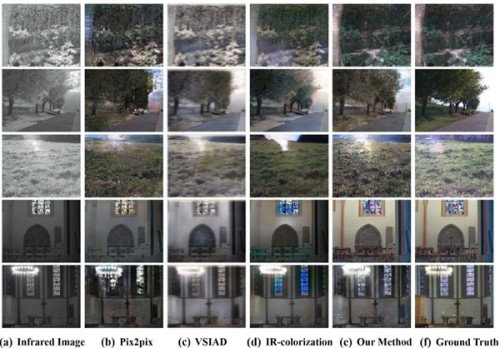
Colorization of Near-Infrared Images and Comparison of Results from Different Algorithms
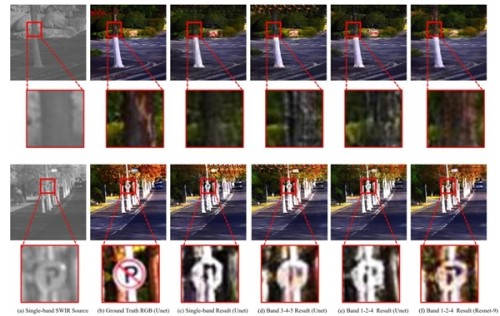
Shortwave Infrared Multispectral Color Reconstruction Results
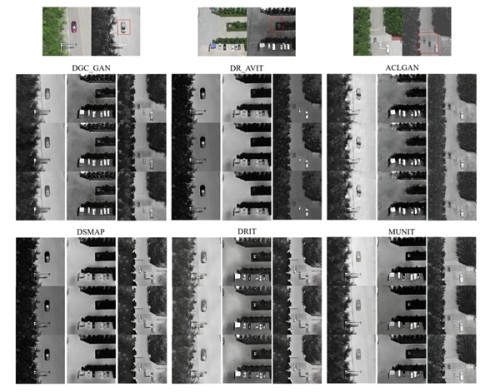
Results of visible-light to thermal-infrared image generation in real-world drone‑based measurements
Source: Anhui Institute of Optics and Fine Mechanics
Thank you for visiting the official website of Chongfan Technology. If you have cooperation intentions or suggestions, please contact us through the following methods, and we will reply as soon as possible, thank you!
Address: Room 403, Building 6, Phase III of R&D, No. 36 Xiyong Avenue, High tech Zone, Chongqing, China.
Telephone: +86-13658337211
E-mail: Sales@cfkeji.net
Website: www.cfkeji.net
Mobile Version
