
Chongfan Technology
News
29
2026
-
09
Progress has been made in the research on photocurable polyurethane elastomers prepared by 3D printing.
Author:
Light-curable 3D-printed polyurethane elastomers hold significant application potential in fields such as flexible electronics, biomedical devices, and soft robotics.
Recently, the Lanzhou Institute of Chemical Physics, Chinese Academy of Sciences, has proposed a synergistic reinforcement strategy based on “chemical crosslinking networks–dynamic supramolecular networks,” enabling the development of a photocurable polyurethane elastomer that simultaneously exhibits high strength and toughness as well as excellent printability.
The team ensures structural stability through a chemically crosslinked network and incorporates UPy motifs capable of forming self-complementary quadruple hydrogen bonds, leveraging their dynamic supramolecular interactions to facilitate molecular chain rearrangement and energy dissipation. Using this approach, the printed polyurethane elastomer exhibits a tensile strength of 26.84 MPa, a toughness of 38.60 MJ·m⁻³, and a Young’s modulus of 34.41 MPa, with an exceptionally low wear rate of 3.62 × 10⁻⁶ mm³·N⁻¹·m⁻¹, thereby achieving a synergistic enhancement of material strength, toughness, and wear resistance.
The team found that, upon dimerization, UPy significantly increases the density of hydrogen bonds within the supramolecular elastomer, thereby enhancing the stability of its network structure. SAXS analysis indicates that the improvement in material properties does not merely stem from an increase in the hard‑segment content; rather, it arises from the synergistic interplay between hard‑phase aggregation and dynamic quadruple hydrogen bonding.
By synergistically designing a dynamic quadruple hydrogen-bonding network based on UPy, a covalent photocrosslinked network, and a microphase-separated structure, the team elucidated the structural reinforcement and energy-dissipation mechanisms of UPy‑based supramolecular interactions in 3D‑printed polyurethane elastomers. This approach effectively resolves the longstanding trade-off between strength, toughness, and wear resistance in photocurable elastomers, offering new insights for the design and fabrication of high‑performance elastomeric materials via additive manufacturing.
The relevant research findings have been published in Aggregate. This work was supported by the National Key R&D Program, the Strategic Priority Program on Space Science of the Chinese Academy of Sciences, and the Chinese Academy of Sciences Special Research Assistant Program, among others.
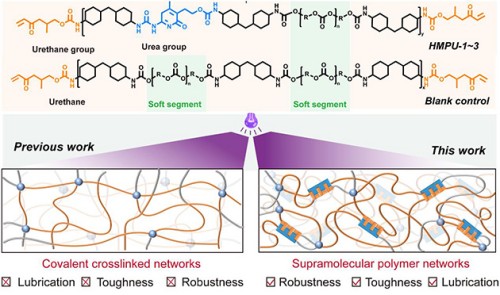
Molecular Structure Design of 3D-Printed Polyurethane Elastomers
Source: Lanzhou Institute of Chemical Physics
Thank you for visiting the official website of Chongfan Technology. If you have cooperation intentions or suggestions, please contact us through the following methods, and we will reply as soon as possible, thank you!
Address: Room 403, Building 6, Phase III of R&D, No. 36 Xiyong Avenue, High tech Zone, Chongqing, China.
Telephone: +86-13658337211
E-mail: Sales@cfkeji.net
Website: www.cfkeji.net
Mobile Version