
Chongfan Technology
News
16
2026
-
09
Progress has been made in low-count PET imaging research.
Author:
PET can visualize human metabolic and molecular processes, playing a crucial role in tumor diagnosis and treatment response assessment. Recently, the Shenzhen Institute of Advanced Technology of the Chinese Academy of Sciences and other institutions have made significant advances in low-count PET imaging.
The research team has proposed a novel AI model framework called “Counting‑Aware Diffusion with Gated Autoregressive Inference.” This model can leverage existing structural and contrastive information to iteratively reduce noise and restore fine details, thereby producing PET images that more reliably approximate the standard counting reference.
The study included whole-body PET/CT data from four hospitals and generated low-count PET images with varying acquisition durations. Results showed that, for low-count images acquired over 3 seconds, the proposed model significantly reduced noise and improved image sharpness and quantitative accuracy. In tests conducted at three independent centers in Shandong, Zhuhai, and Wuhan, the method demonstrated consistent performance across different acquisition times, highlighting its robust adaptability to diverse hospital settings and data distributions.
The relevant research findings were published in Medical Image Analysis. This work was supported by the National Natural Science Foundation of China, the National Key R&D Program, and the Chinese Academy of Sciences’ Scientific Instrument and Equipment Development Project, among others.
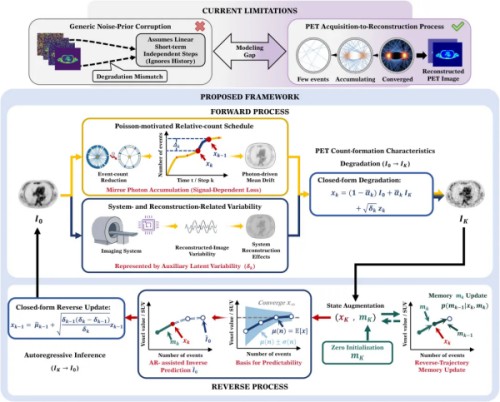
Counting-aware Diffusion and Gated Autoregressive Reasoning Framework
Source: Shenzhen Institute of Advanced Technology
Previous
Previous
Thank you for visiting the official website of Chongfan Technology. If you have cooperation intentions or suggestions, please contact us through the following methods, and we will reply as soon as possible, thank you!
Address: Room 403, Building 6, Phase III of R&D, No. 36 Xiyong Avenue, High tech Zone, Chongqing, China.
Telephone: +86-13658337211
E-mail: Sales@cfkeji.net
Website: www.cfkeji.net
Mobile Version