
Chongfan Technology
News
07
2026
-
08
Adv. Photon. | Multilayer synchronous polarization projection, breaking the theoretical limit of crosstalk in multi-channel polarization averaging
Author:
Background Introduction
In the field of optical information processing, optical degrees of freedom—such as wavelength, propagation angle, and orbital angular momentum—can all be used to achieve parallel encoding of multiple signals, thereby increasing the system’s information-carrying capacity. Corresponding multiplexing techniques have already found widespread application in areas like optical communications, holography, and quantum information. Polarization, as an intrinsic fundamental property of light, offers the advantages of simple manipulation and low complexity in both generation and detection; accordingly, it is also employed as an information carrier, with extensive use in metasurface holography, optical encryption, and multi‑channel imaging. In linear optical systems, any arbitrary polarization state can be expressed as a linear combination of two orthogonal basis states; by adjusting the relative weights assigned to these basis states, one can control the polarization angle of the incident light. However, when the number of multiplexed channels approaches its theoretical upper limit, it becomes difficult to achieve complete extinction in non‑target channels, leading to severe inter‑channel crosstalk. Moreover, existing approaches typically rely on non‑orthogonal polarizations or artificial noise to increase channel count; yet, to minimize signal overlap, different channels must be allocated to distinct spatial regions, which in turn results in additional spatial overhead and imposes constraints on the information capacity of compact optical devices.
In response to the aforementioned issues, A research team at the University of Paderborn in Germany has proposed a novel multi-layer simultaneous polarization projection method. This method repeatedly introduces polarization projection during light-field propagation, enabling the system to generate higher-order polarization responses and extending the controllable polarization degrees of freedom to twice the number of projection layers. Building on this, the authors also demonstrated six-channel polarization holography without requiring positional multiplexing, and in seven-channel polarization multiplexing, they surpassed the conventional theoretical limit of 3.98 dB for average crosstalk, achieving an average crosstalk as low as −2.54 dB. These findings provide valuable insights for advancing high-dimensional optical information‑encoding technologies in areas such as optical communications, information encryption, and imaging; the relevant results have been published as… “ Increasing the design degree of freedom for polarization through multilayer synchronous polarization projection ” Published under the title Advanced Photonics Journal.
Multi-layer synchronous polarization projection, expanding the degrees of freedom in polarization multiplexing.
As shown in Fig. 1(a), the research team integrated a reflective metasurface with a rotatable reflective wire‑grid polarizer to construct a multilayer synchronous polarization‑projection system. After the light beam is modulated by the metasurface, it is projected by the synchronously rotating polarizer and then propagates into the next layer. Through the cumulative effect of this multilayer architecture, the optical field undergoes repeated polarization modulation and projection during propagation, yielding higher‑order polarization responses that are difficult to achieve with conventional single‑layer devices. Traditional polarization multiplexing is constrained by two orthogonal polarization basis states; as the number of channels increases, residual signals in non‑target channels give rise to significant crosstalk, as illustrated in Fig. 1(b). In contrast, the multilayer synchronous polarization‑projection scheme can achieve signal extinction across a broader range of polarization angles, effectively suppressing unwanted channels, as depicted in Fig. 1(c). Theoretical analysis indicates that each additional layer of synchronous polarization projection adds two effective degrees of freedom; when the number of projection layers reaches L, the total controllable polarization degrees of freedom expand to 2L, thereby surpassing the two‑degree‑of‑freedom limit of conventional polarization multiplexing and providing a foundation for the independent encoding and readout of multi‑channel information.
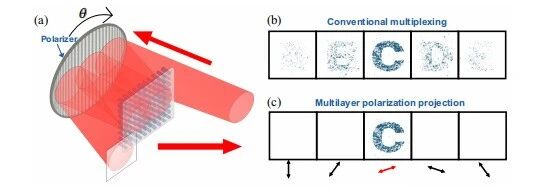
Figure 1 Schematic diagram of how multi-layer synchronous polarization projection enhances the degrees of freedom in polarization multiplexing.
Cooperative control by a double-layer metasurface enables four-channel polarization holography.
To validate this method, the authors’ team constructed a dual-layer synchronous polarization‑projection system. As shown in Fig. 2(a), the two metasurface layers were jointly optimized so that distinct incident polarization states correspond to pre‑defined holographic images. Figure 2(b) illustrates the reflective silver‑based metasurface unit cell, while Fig. 2(c) presents a scanning electron microscope image of the fabricated metasurface. The reflective configuration helps reduce the overall system footprint and simplifies the alignment of multilayer devices. As depicted in Fig. 2(d), the research team encoded the digital values 0, 1, 2, and 3 at polarization angles of 0°, 45°, 90°, and 135°, respectively. The experimental results are in good agreement with the simulations: the four images can be independently displayed at the same spatial location depending on the incident polarization, without requiring separate regions for each channel. The peak signal‑to‑noise ratios for the four experimental channels reach 13.5, 12.8, 12.2, and 12.9 dB, demonstrating the feasibility of achieving multi‑channel holographic reconstruction via dual‑layer synchronous polarization projection.
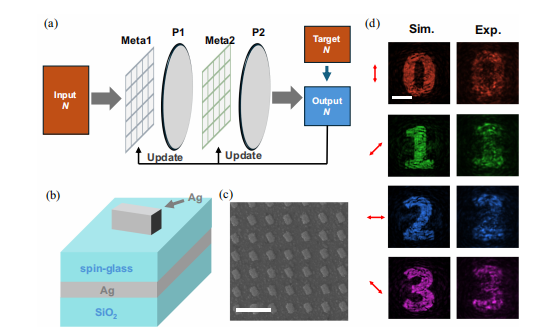
Figure 2: Design of dual-layer synchronous polarization projection and experimental results of four-channel polarization holography.
Multi-channel polarization multiplexing significantly enhances channel isolation.
The authors further compared conventional polarization multiplexing with a two-layer synchronous polarization projection. As shown in Fig. 3(a), in six-channel multiplexing, the conventional single-layer approach struggles to suppress all non-target signals simultaneously, resulting in significant background noise across all channels. In contrast, after adopting the two-layer synchronous polarization projection, the edges of the target fringes become much sharper, and the background signal is markedly reduced; experimental results also show good agreement with simulations. As illustrated in Fig. 3(b), in the 90° polarization channel, the extinction ratio of the conventional single-layer design is only 0.80 dB. With the introduction of the second-layer synchronous polarization projection, the simulated and experimental extinction ratios improve to 5.91 dB and 4.59 dB, respectively. Across all six channels, this method increases the average extinction ratio by 3.79 dB, significantly enhancing isolation between different polarization channels. To further validate the scalability of the proposed approach, the research team designed a seven-channel system employing four layers of projection. For conventional polarization multiplexing, the theoretical limit for average crosstalk is 3.98 dB; in this new design, the average crosstalk is reduced to −2.54 dB, representing an average improvement of 6.52 dB, thereby demonstrating its potential for high-dimensional polarization information encoding.
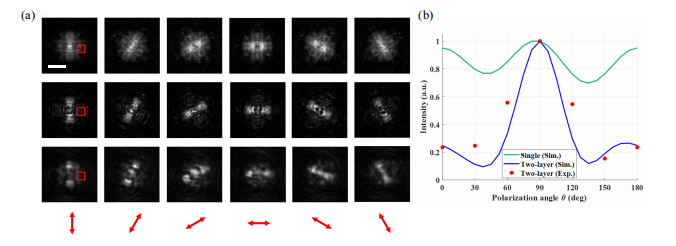
Figure 3: Comparison of six-channel results between conventional polarization multiplexing and synchronous polarization projection.
Summary and Outlook
This study proposes a multilayer synchronous polarization‑projection method that, by repeatedly modulating and projecting polarization during light propagation, generates higher‑order polarization responses, thereby doubling the system’s available polarization degrees of freedom relative to the number of projection layers. Based on this approach, the research team demonstrated four‑channel and six‑channel polarization holography without spatial multiplexing; in the six‑channel case, the average extinction ratio improved by 3.79 dB. Furthermore, in a seven‑channel design employing four projection layers, the average crosstalk was reduced to −2.54 dB, surpassing the conventional theoretical limit of 3.98 dB for polarization multiplexing. This work overcomes the longstanding bottleneck of traditional polarization multiplexing, which is constrained by only two orthogonal polarization basis states, offering new avenues for increasing polarization information capacity and enabling high‑dimensional optical information encoding. Looking ahead, with further optimization of metasurface designs and precise alignment of multilayer devices, this method can be integrated with wavefront control, metalenses, and fiber‑optic systems, providing technological foundations for high‑capacity optical communications, optical encryption, and multi‑channel imaging.
Journal Overview
Advanced Photonics (AP), founded in 2019, is an international open-access journal that focuses on both fundamental and applied research in emerging areas of optics, highlighting the latest developments and rapid advances in the fields of optics and photonics. The journal was selected for the China Association for Science and Technology’s High‑Start New Journal Program and was indexed by SCI in 2021. With a recent impact factor of 18.8, it ranks 7th (Q1) among global JCR‑indexed optics journals, is classified as Zone 1 by the Chinese Academy of Sciences, and has been included in the second phase of China’s Plan for Excellence in Scientific Journals. Since its inception, AP has published numerous high‑level academic papers by leading international scholars and, through interviews, news articles, commentaries, and other formats, has showcased the most recent advances in optics and photonics. Sister journal Advanced Photonics Nexus (APN) Accepts rapid submissions from AP and original contributions, striving to become a comprehensive, high‑impact journal that publishes both fundamental research and engineering applications. In 2025, it is expected to achieve its first impact factor of 6, and in 2024, it was selected for the China Science and Technology Journals Excellence Action Plan’s High‑Start New Journal Program.
Original article link: https://mp.weixin.qq.com/s/QjRevvr7Fctizf9VRRn8TQ
LATEST NEWS
Thank you for visiting the official website of Chongfan Technology. If you have cooperation intentions or suggestions, please contact us through the following methods, and we will reply as soon as possible, thank you!
Address: Room 403, Building 6, Phase III of R&D, No. 36 Xiyong Avenue, High tech Zone, Chongqing, China.
Telephone: +86-13658337211
E-mail: Sales@cfkeji.net
Website: www.cfkeji.net
Mobile Version
