
Chongfan Technology
News
30
2026
-
07
Soochow University: Organic Photovoltaics | Nature Reviews Clean Technology
Author:
The certified power conversion efficiency of organic photovoltaics (OPVs) has exceeded 21%, bringing device performance into a range that is viable for commercial applications.
Recently, the team of Academician Yongfang Li at Soochow University, including Yaowen Li and Haiyang Chen, published a review article in Nature Reviews Clean Technology, summarizing the efficiency, stability, and large-scale applications of organic photovoltaics.
From the perspectives of efficiency optimization, long-term operational stability, scalable processing, and manufacturing cost, this work systematically analyzes the evolution of organic photovoltaics. It summarizes research strategies across several key areas, including active‑material design, additive engineering, self‑assembled interlayers, and the regulation of synthetic complexity. Furthermore, it elucidates how molecular structure, aggregation behavior, interfacial energy‑level characteristics, and material cost collectively determine device performance and degradation mechanisms.
The mechanisms limiting device stability encompass multiple levels, including intrinsic material properties, bulk heterojunction morphology, and the buried interface. This underscores the need to unravel the system‑level coupling effects among these factors under practical operating conditions. To advance organic photovoltaics toward real‑world applications, it is essential to address key technical challenges such as environmentally friendly processability, thick‑film robustness, fluid‑dynamics‑based coating control, mechanical flexibility, and semi‑transparent device architectures. Currently, large‑area modules with an active area exceeding 10 cm² and a power conversion efficiency of ≥15% have been successfully fabricated, marking a significant milestone in the development of scalable manufacturing technologies.
By integrating multidimensional technological advances—ranging from materials and interfaces to device architectures and cost‑oriented design—applications such as wearable electronics, indoor energy harvesting, building‑integrated photovoltaics, and agrivoltaic systems are poised for realization. The report also emphasizes that all‑flexible organic solar cells require further optimization of electrode, active‑layer, and interface properties to withstand sustained, multi‑directional, and localized mechanical deformations.
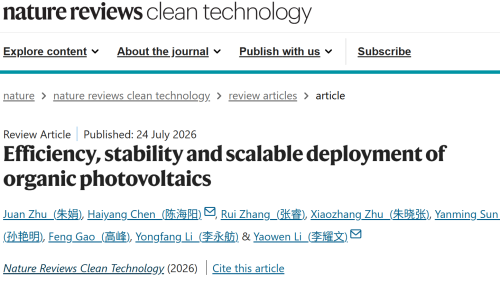
Efficiency, stability and scalable deployment of organic photovoltaics. Efficiency, stability, and scalable deployment of organic photovoltaics.
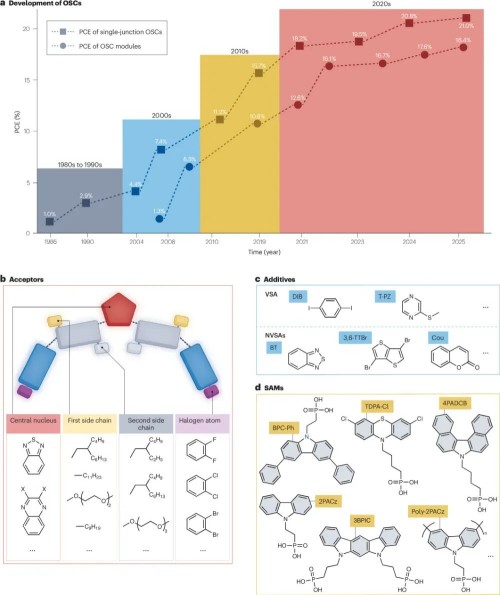
Figure 1 | Efficiency Enhancement of Organic Solar Cells and the Development Roadmap for Key Materials
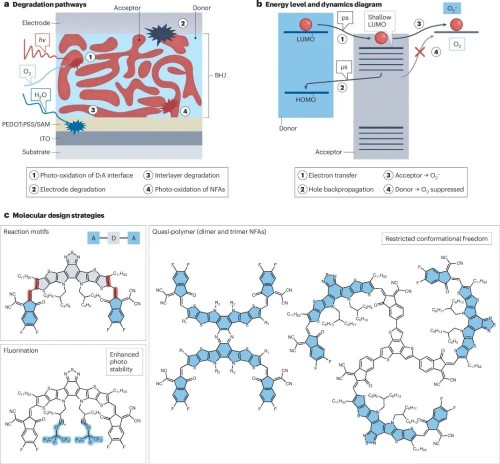
Figure 2 | Degradation pathways and design principles for the stability of organic photovoltaic devices
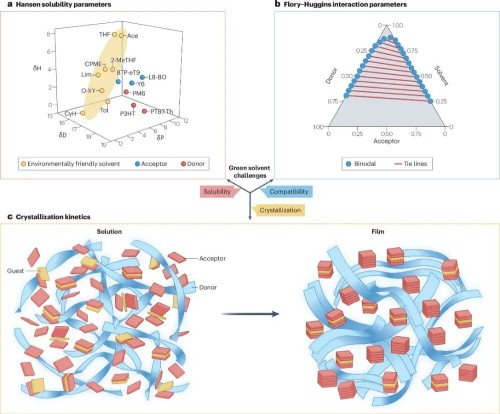
Figure 3 | Construction of a high-performance active layer via environmentally friendly solvent processing
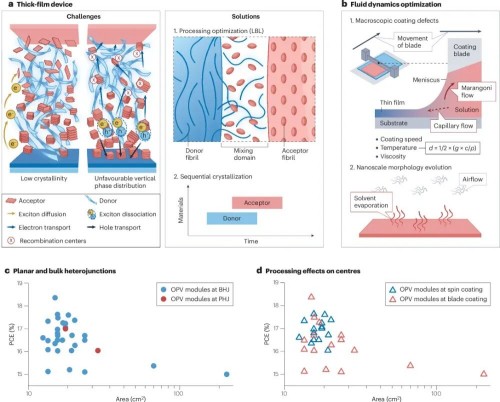
Figure 4 | Morphology Control of Thick Films and Performance Comparison of Large-Area Modules
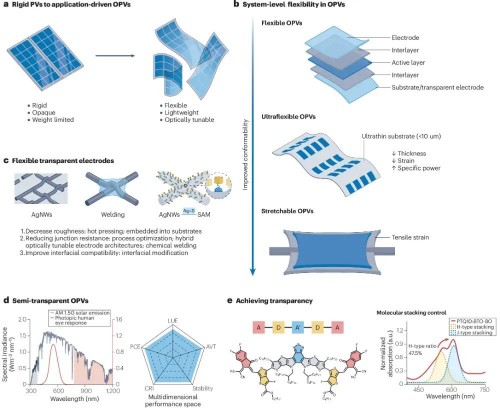
Figure 5 | Flexibilization, morphological diversification, and semi-transparency of organic photovoltaics
Source: Today’s New Materials
Previous
Previous
LATEST NEWS
Thank you for visiting the official website of Chongfan Technology. If you have cooperation intentions or suggestions, please contact us through the following methods, and we will reply as soon as possible, thank you!
Address: Room 403, Building 6, Phase III of R&D, No. 36 Xiyong Avenue, High tech Zone, Chongqing, China.
Telephone: +86-13658337211
E-mail: Sales@cfkeji.net
Website: www.cfkeji.net
Mobile Version