
Chongfan Technology
News
30
2026
-
07
Wuhan University, Spin-Activated Light-Emitting Diodes | Nature Photonics
Author:
Spin light-emitting diodes have attracted considerable attention due to their promising applications in next-generation optoelectronic devices, spin photonics, and optical communications. However, at room temperature, spin polarization decays rapidly because of fast spin relaxation, which severely limits the brightness of asymmetric electroluminescence—typically ranging from 10 to 1,000 cd m⁻².
Recently, the team of Hou Shaocong at Wuhan University, including Qi Liu and Yanlong Wang, published a paper in Nature Photonics describing the construction of a hybrid chiral perovskite heterostructure. In this structure, a non‑chiral emissive layer is embedded within a wide‑bandgap chiral spin‑injection layer, spatially separating the emissive layer from the spin‑injection layer and thereby enabling precise control over the contribution of exciton–exciton interactions to spin relaxation.
This hybrid chiral perovskite effectively suppresses the rapid increase in spin-flip rate that occurs with rising excitation density, extending the spin relaxation time to the nanosecond regime while maintaining a photoluminescence quantum efficiency of 78%. Spin‑emitting diodes fabricated based on this heterostructure achieve a BCP‑EL of 13,084 cd m⁻², with a maximum electroluminescence asymmetry factor of 0.2. At an initial brightness of 100 cd m⁻², the device exhibits an extrapolated half‑life exceeding 5,000 hours.
Kinetic analysis indicates that the determinants of luminescence polarization shift with the excitation conditions: at low excitation densities, it is primarily governed by the initial spin polarization, whereas at high excitation densities, it is predominantly controlled by the spin-flip rate.
This study not only unveils a novel mechanism of spin dynamics but also offers new design principles for high-performance spin‑emitting devices and for the advancement of next‑generation display, quantum information, and spinphotonics technologies.
Manipulating spin dynamics via exciton–exciton interactions for bright spin light-emitting diodes. By leveraging exciton–exciton interactions to control spin dynamics, it is possible to realize high-brightness spin light-emitting diodes.
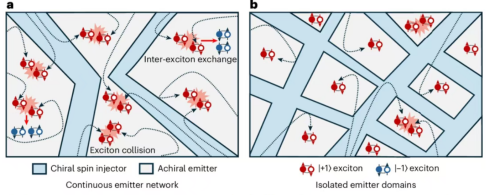
Figure 1: Chiral perovskites with continuous and segmented emitter networks; exciton distribution and spin dynamics in HCP.
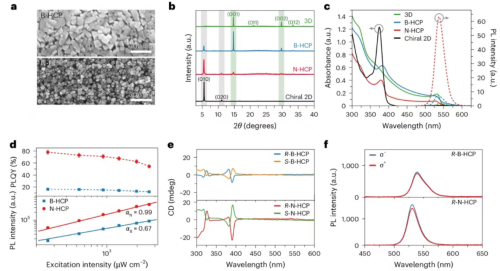
Figure 2: Structure, optical properties, and chiroptical properties of the chiral perovskite HCP.
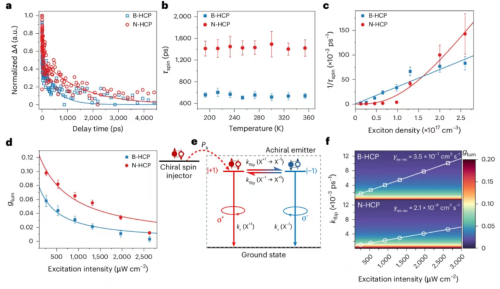
Figure 3: Spin dynamics and dynamical model of the chiral perovskite HCP.
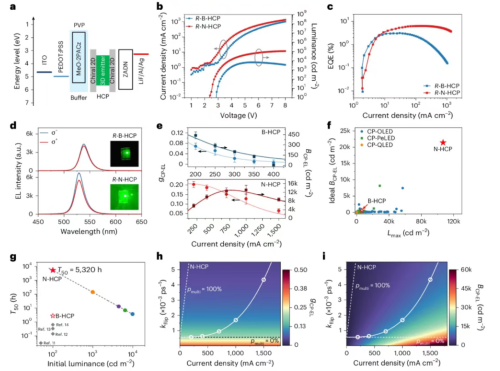
Figure 4: Spin‑LED device performance based on chiral perovskite HCP, along with circularly polarized electroluminescence (CP‑EL).
Source: Today’s New Materials
LATEST NEWS
Thank you for visiting the official website of Chongfan Technology. If you have cooperation intentions or suggestions, please contact us through the following methods, and we will reply as soon as possible, thank you!
Address: Room 403, Building 6, Phase III of R&D, No. 36 Xiyong Avenue, High tech Zone, Chongqing, China.
Telephone: +86-13658337211
E-mail: Sales@cfkeji.net
Website: www.cfkeji.net
Mobile Version