
Chongfan Technology
News
07
2026
-
07
Reconfigurable Giant Nonreciprocity for Near-Normal Incidence Based on Phase-Change Magneto-Optic Metagratings
Author:
The teams of Ye Mingqing at Nanjing University of Posts and Telecommunications, Koichi Okamoto and Shunsuke Murai at Osaka Metropolitan University, and Zhaogang Dong at the Agency for Science, Technology and Research in Singapore have demonstrated a dynamic, nonvolatile, nonreciprocal absorber that integrates a phase-change GeSbTe (GST) grating atop a magneto‑optical InAs waveguide. Leveraging the transverse magneto‑optic response in a Voigt configuration and precise momentum matching, this metagrating achieves a strong nonreciprocal absorption contrast (~0.9) at a near‑normal incidence angle of 3° under moderate magnetic fields. The device enables continuous spectral tuning via both the incidence angle and the magnetic field, while the GST switch provides nonvolatile digital latching of the nonreciprocal state. Using non-Hermitian perturbation theory, the authors show that the suppression of nonreciprocity during the phase transition arises from the synergistic interplay of spatial field redistribution and damping induced by losses. Their findings offer a robust, nonvolatile platform for advanced thermal radiation control.
The research findings were published on June 25, 2026, in Laser & Photonics Reviews, under the title “Reconfigurable Giant Nonreciprocity at Near-Normal Incidence via Phase-Change Magneto-Optical Metagratings.”
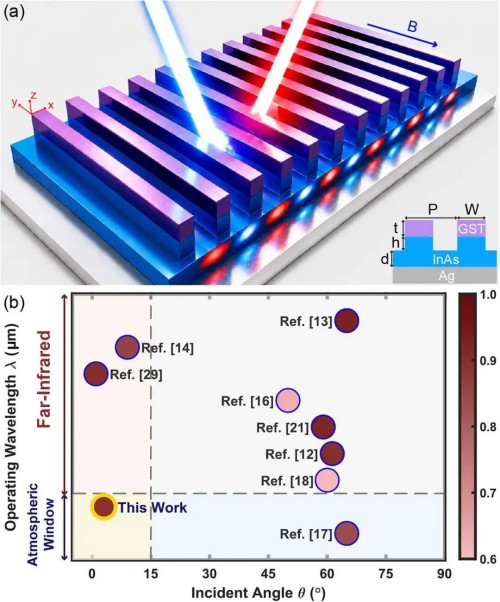
Figure 1: (a) Schematic diagram of a magneto‑tunable nonreciprocal absorber based on a hybrid phase‑change metagrating.
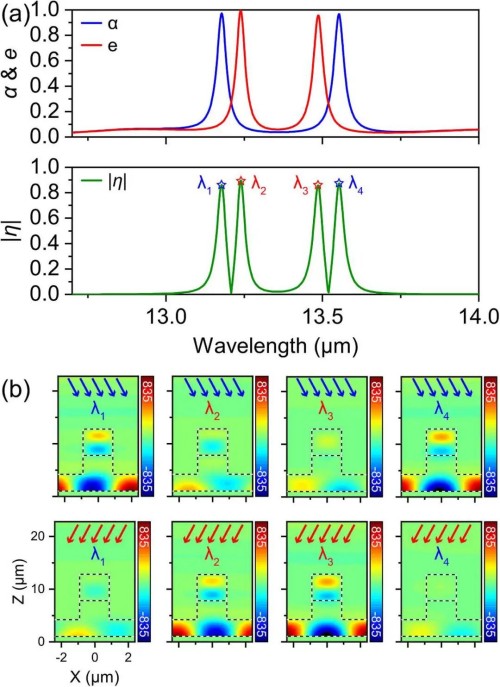
Figure 2: Demonstration of the substantial nonreciprocal absorption and directional absorption contrast under nearly normal incidence.
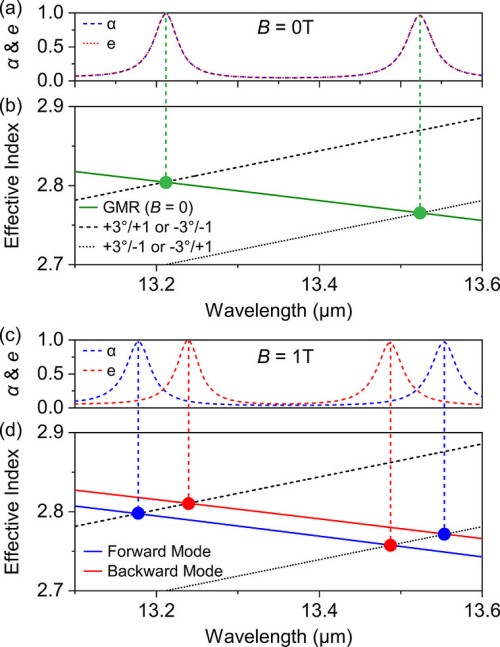
Figure 3: Theoretical validation and dispersion analysis of guided-mode resonance.
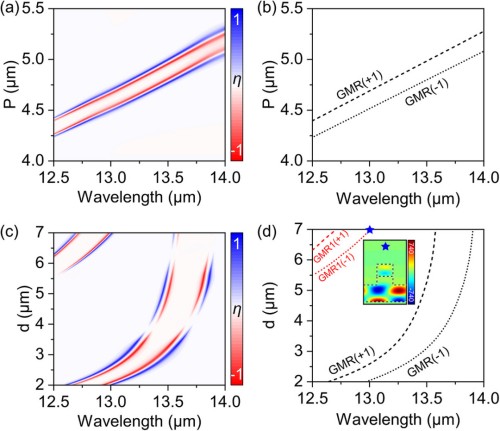
Figure 4: (a) Evolution of the nonreciprocal factor η with grating period P at B = 1 T.
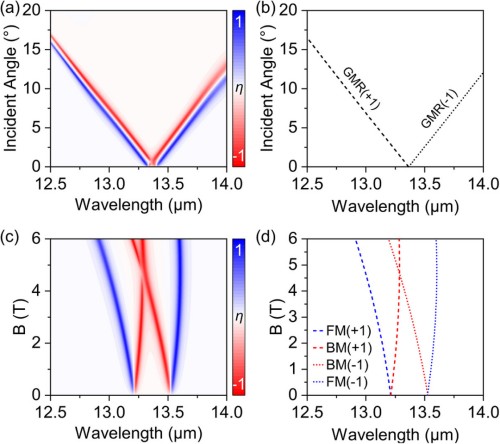
Figure 5: (a) Nonreciprocal spectrum η(θ,λ) at B = 1 T
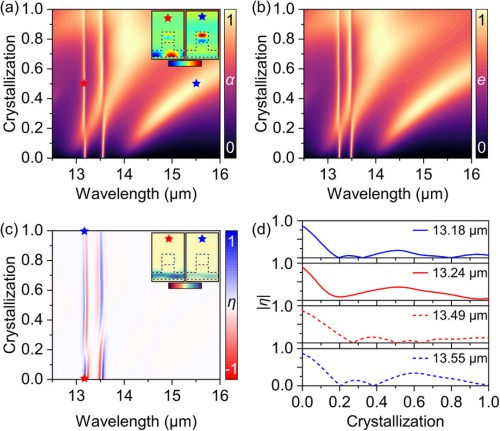
Figure 6: Evolution of the Absorption Spectrum
Source: Optics World
LATEST NEWS
Thank you for visiting the official website of Chongfan Technology. If you have cooperation intentions or suggestions, please contact us through the following methods, and we will reply as soon as possible, thank you!
Address: Room 403, Building 6, Phase III of R&D, No. 36 Xiyong Avenue, High tech Zone, Chongqing, China.
Telephone: +86-13658337211
E-mail: Sales@cfkeji.net
Website: www.cfkeji.net
Mobile Version