
Chongfan Technology
News
07
2026
-
07
Thermally Modulated Metasurface Sensor for Dynamic and Time-Resolved Separation of Extracellular Vesicles
Author:
The team led by Fatih Inci at Bilkent University in Turkey has developed a thermoresponsive polymer‑integrated plasmonic metasurface sensor capable of spatiotemporally controlled, label‑free isolation of extracellular vesicles (EVs). The metasurface is engineered from nano‑grating discs and functionalized with poly(N‑isopropylacrylamide) (PNIPAM) and anti‑CD63 antibodies, enabling selective EV capture at physiological temperatures and gentle release upon minute temperature changes near the polymer’s lower critical solution temperature (~35°C). Using EVs derived from MCF‑7 and HEK‑293 cells as a proof of concept, the platform demonstrates a dynamic detection range spanning three orders of magnitude. Release efficiency reaches 87.03 ± 23.5%, and both nanoparticle tracking analysis (NTA) and fluorescence NTA (fNTA) reveal an approximately 100‑fold improvement in EV purity compared with ultrafiltration. Electron microscopy and Western blotting confirm the integrity of vesicle morphology and marker expression. By integrating thermoresponsive chemistry with a cost‑effective metasurface platform, this system offers a nondestructive, portable, and real‑time solution for precise manipulation of extracellular vesicles, advancing cell‑vesicle‑centric biosensing and point‑of‑care diagnostic strategies with potential future applications in liquid biopsies.
The research findings were published in Advanced Materials on May 8, 2026, under the title “Thermally Modulated Metasurface Sensor for Dynamic and Time-Resolved Isolation of Extracellular Vesicles.”
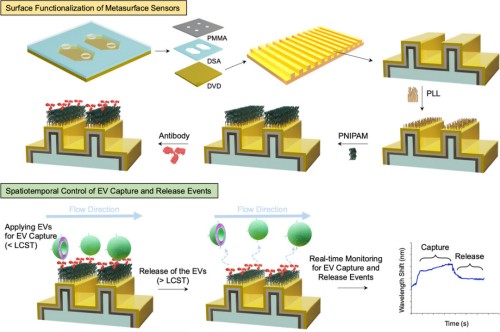
Figure 1: Schematic diagram of a thermoresponsive polymer‑functionalized metasurface sensor for the spatiotemporal capture and release of extracellular vesicles.
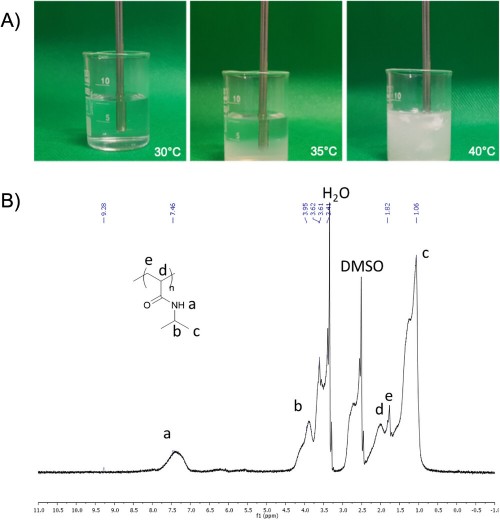
Figure 2: Characterization of the thermoresponsive polymer (PNIPAM)
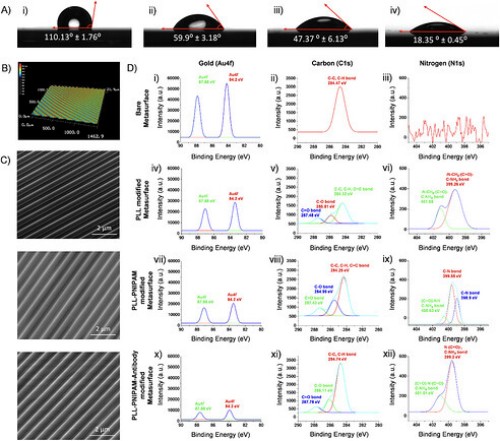
Figure 3: Characterization of the metasurface sensor
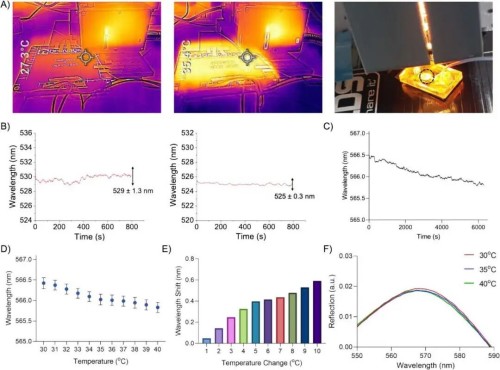
Figure 4: Optimization of the concentration and temperature response of the thermoresponsive polymer (PNIPAM)
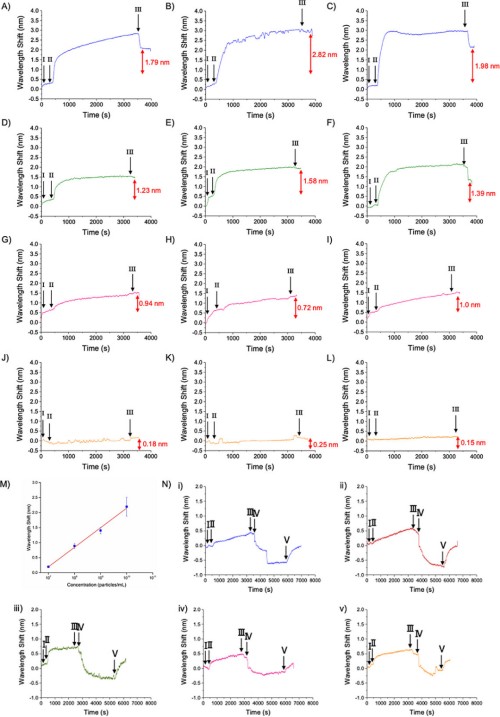
Figure 5: Real-time monitoring of the capture and thermally triggered release of extracellular vesicles (EVs) using a sensor modified with PLL‑PNIPAM and anti‑CD63 antibodies.
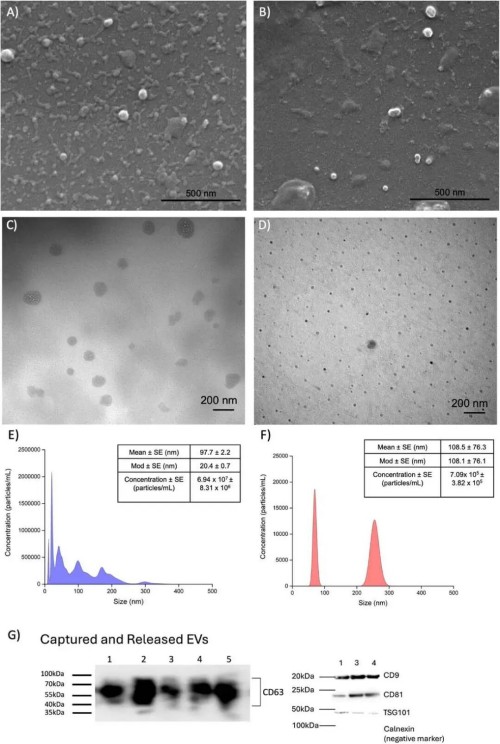
Figure 6: Characterization of extracellular vesicles isolated after release events from a sensor modified with PLL‑PNIPAM‑anti‑CD63 antibody and blocked with BSA.
Source: Optics World
LATEST NEWS
Thank you for visiting the official website of Chongfan Technology. If you have cooperation intentions or suggestions, please contact us through the following methods, and we will reply as soon as possible, thank you!
Address: Room 403, Building 6, Phase III of R&D, No. 36 Xiyong Avenue, High tech Zone, Chongqing, China.
Telephone: +86-13658337211
E-mail: Sales@cfkeji.net
Website: www.cfkeji.net
Mobile Version