
Chongfan Technology
News
03
2026
-
07
Fermi Superfluid | Nature Physics
Author:
Fermionic many-body systems provide a platform for investigating how interactions drive collective quantum phenomena, including macroscopic coherence and superfluidity. At the heart of these phenomena lies the formation of Cooper pairs—correlated states composed of two fermions that behave as composite bosons and undergo Bose–Einstein condensation below a critical temperature. Unlike fundamental bosons, these Cooper pairs retain an internal structure dictated by the correlations among their constituent fermions, which is essential for understanding superfluid properties across the crossover regime from Bose–Einstein condensation to Bardeen–Cooper–Schrieffer superconductivity.
Recently, M. Frómeta Fernández, G. Roati, and others from the University of Florence in Italy published a paper in Nature Physics, in which they used an acoustic Sagnac interferometer to directly measure the angular momentum of a rotating Fermi superfluid.
The experiment confines an ultracold lithium atomic gas in a ring-shaped trap and excites counter‑propagating phonon modes to generate interference. By injecting quantized superfluidity into the ring, the phonon frequencies undergo Doppler splitting, causing the interference fringes to precess. The circulation quantum of a Fermi superfluid is h/2m (where m is the atomic mass), demonstrating that superfluidity is carried by Cooper pairs rather than by individual particles. This technique also offers a new approach for measuring the superfluid fraction in unitary Fermi gases. Analogous to the optical Sagnac effect, an acoustic version of the ring‑interference platform was constructed, and the composite nature of the Fermi condensate during this transition was probed.
By coherently exciting, via a weak optical potential, a ring-shaped Fermi superfluid with tunable interactions using two counter‑propagating long‑wavelength phonons, we realized an in situ ring interferometer. By injecting quantized superflow into the superfluid ring, we lifted the frequency degeneracy between the clockwise and counterclockwise acoustic modes. The resulting Doppler shifts can be used to probe the fundamental quantum of angular momentum in the Fermi fluid as well as the angular momentum per particle. Experimental observations reveal that the quantized units of superfluid circulation are determined by pairs of fermions, thereby providing a means to measure the fractional superfluidity of a unitary Fermi gas at low temperatures.
This achievement has established the phonon interference measurement method, which can serve as a detection technique for strongly correlated quantum systems.

Angular momentum of rotating fermionic superfluids by Sagnac phonon interferometry. Angular momentum of rotating fermionic superfluids: Sagnac phonon interferometry
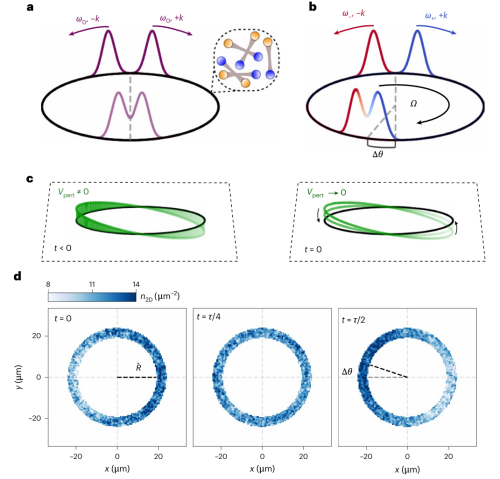
Figure 1: A Sagnac-like matter-wave interferometer in a ring-shaped Fermi superfluid.
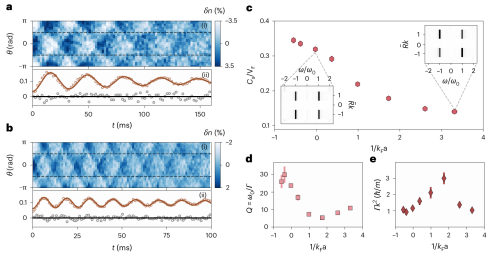
Figure 2: Measurement of phonon interference across the Bose–Einstein condensation transition.
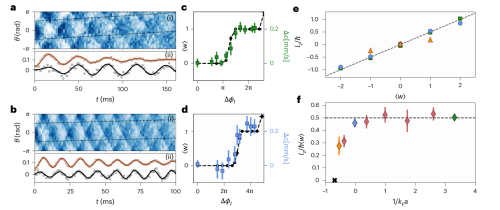
Figure 3: Phonon Doppler shift at the BEC–BCS crossover as a function of the angular momentum per particle.
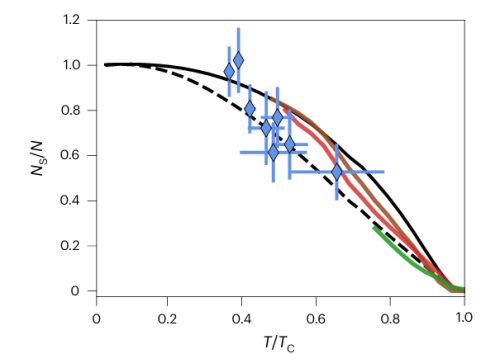
Figure 4: Superfluid fraction under unitarity.
Source: Today’s New Materials
LATEST NEWS
Thank you for visiting the official website of Chongfan Technology. If you have cooperation intentions or suggestions, please contact us through the following methods, and we will reply as soon as possible, thank you!
Address: Room 403, Building 6, Phase III of R&D, No. 36 Xiyong Avenue, High tech Zone, Chongqing, China.
Telephone: +86-13658337211
E-mail: Sales@cfkeji.net
Website: www.cfkeji.net
Mobile Version