
Chongfan Technology
News
29
2026
-
06
Current Status and Future Prospects of Mid-Infrared Free-Space Optical Communication
Author:
Recently, Researcher Hui‑bin Zhou of the School of Optoelectronic Information at Huazhong University of Science and Technology, together with the team led by Academician Alan Willner of the University of Southern California, was invited to co‑author an extensive review article titled “Mid‑infrared Free‑Space Optical Communications: A Tutorial.” This review systematically traces the evolution of free‑space optical communication in the mid‑infrared band, providing a comprehensive overview that covers atmospheric transmission effects in the mid‑infrared region, transmitter and receiver components, demonstrations of both single‑channel and multi‑channel high‑speed links, key technological bottlenecks, and promising directions for future research. The review was published in the recent issue of Advances in Optics and Photonics.
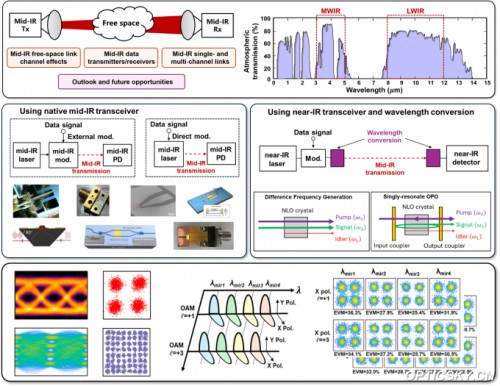
This paper reviews the recent advances in mid-infrared free-space optical (FSO) communication technology. Free-space optical communication leverages light waves to transmit information through atmospheric, space-based, and other channels, offering advantages such as high bandwidth, strong directivity, and resistance to interception. Currently, most FSO systems operate in the near-infrared 1.55 μm band; while the associated components are well‑established, this wavelength range is susceptible to atmospheric absorption, scattering, and turbulence, leading to degraded performance. In contrast, the two atmospheric windows in the mid‑infrared—3–5 μm and 8–12 μm—are characterized by longer wavelengths and weaker light–matter interactions, resulting in enhanced transmission robustness under challenging conditions such as fog, aerosols, and turbulent atmospheres.
This review systematically outlines the evolution of this field: in terms of atmospheric link effects, the mid-infrared region can effectively mitigate degradation caused by absorption, scattering, and turbulence; regarding transceiver technologies, it is categorized into two approaches—native mid-infrared devices (such as quantum cascade lasers and interband cascade lasers) and nonlinear wavelength‑conversion–based schemes (including difference‑frequency generation and optical parametric oscillation); in link demonstrations, it encompasses both intensity modulation/direct detection and coherent detection, as well as multi‑channel systems employing polarization, wavelength division, and mode multiplexing. Future research directions include on‑chip integrated components, optimization of light‑source performance, integrated sensing‑and‑communication architectures, and quantum communication. With ongoing advances in device and integration technologies, mid‑infrared free-space optical communication holds promise as a key technological pathway for achieving higher‑speed, more robust, and secure wireless optical links under challenging atmospheric conditions.
Source: Huazhong University of Science and Technology
LATEST NEWS
Thank you for visiting the official website of Chongfan Technology. If you have cooperation intentions or suggestions, please contact us through the following methods, and we will reply as soon as possible, thank you!
Address: Room 403, Building 6, Phase III of R&D, No. 36 Xiyong Avenue, High tech Zone, Chongqing, China.
Telephone: +86-13658337211
E-mail: Sales@cfkeji.net
Website: www.cfkeji.net
Mobile Version