
Chongfan Technology
News
29
2026
-
06
The Shanghai Institute of Optics and Fine Mechanics has achieved significant progress in the research field of ultrafast laser surface modification of aerospace aluminum alloys.
Author:
Recently, the research team led by Researcher Yang Shanglu from the High-End Optoelectronic Equipment Department of the Shanghai Institute of Optics and Fine Mechanics, Chinese Academy of Sciences, in collaboration with the Aviation Manufacturing Technology Research Institute of Shanghai Aircraft Manufacturing Co., Ltd., has achieved a significant breakthrough in the field of surface modification for aerospace aluminum alloys. The team has, for the first time, proposed and experimentally validated a novel strategy that employs megahertz (MHz) pulse‑train–based picosecond lasers to fabricate micro‑ and nano‑structured surfaces on 2024‑T3 aluminum alloy. By precisely tuning the number of sub‑pulses within each pulse train (Nburst) and the pulse energy, the researchers successfully induced a unique multilayered “sputtering‑like” hierarchical micro‑nanostructure. This approach not only reduces the effective energy threshold required for wettability modulation by 75–80% but also increases the interfacial adhesion strength between epoxy resin and aluminum alloy by nearly 5.7 times, offering a groundbreaking solution for green and efficient surface pretreatment in the aerospace sector. The relevant findings have been published in Applied Surface Science under the title “Surface Processing of Aluminum Alloys Using Burst Ultrafast Laser Pulses for Enhanced Wettability Modulation and Surface Adhesion.”
Aviation-grade aluminum alloys, such as 2024‑T3, are widely employed in critical load‑bearing structures like aircraft wing leading edges due to their high specific strength. However, epoxy protective coatings often crack and delaminate because of insufficient interfacial adhesion, which can trigger corrosion and compromise both the aircraft’s corrosion resistance and passenger comfort. Although conventional chemical pretreatment methods, such as chromic acid anodizing, can enhance adhesion, their use of toxic chemicals is increasingly constrained by environmental regulations, and they suffer from complex processing and poor stability. To address this bottleneck, the research team leveraged the ultrafast energy deposition and cumulative thermal effects of MHz pulse‑train picosecond lasers to achieve precise control over the micro‑ and nano‑topography of aluminum alloy surfaces. In terms of wettability modulation, a single pulse requires 50–100 μJ to induce a marked hydrophilic transition; by contrast, with the introduction of MHz pulse trains, only 10–25 μJ suffices to attain superhydrophilic behavior (contact angle < 10°), reducing the effective energy threshold by approximately 75–80%.
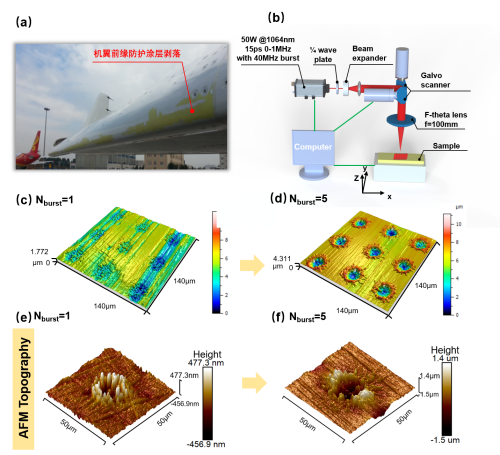
Figure 1: (a) Photograph of the delaminated protective coating on the wing leading edge; (b) Schematic diagram of the picosecond laser processing experimental setup; (c) White-light interferometry (WLI) three-dimensional topography at Nburst = 1; (d) White-light interferometry (WLI) three-dimensional topography at Nburst = 5; (e) Atomic force microscopy (AFM) three-dimensional topography at Nburst = 1; (f) Atomic force microscopy (AFM) three-dimensional topography at Nburst = 5.
This study is the first to apply MHz‑pulsed ultrafast laser processing to the surface functionalization of aerospace aluminum alloys. By engineering a unique “sputter‑like” hierarchical micro‑nanostructure, it achieves an almost sixfold increase in bonding strength under extremely low pulse energies, while fully elucidating the multiscale “energy–structure–property” coupling mechanism underlying this enhancement. These findings offer an efficient, clean, and controllable green manufacturing route that can replace conventional chemical treatments, which are environmentally unfriendly and unstable, and hold significant implications for improving the durability of coating adhesion on wind‑eroded components such as aircraft wing leading edges. Moreover, this technology demonstrates broad application potential in the high‑performance fabrication of metal–polymer hybrid structures across automotive, marine, and advanced‑equipment sectors.
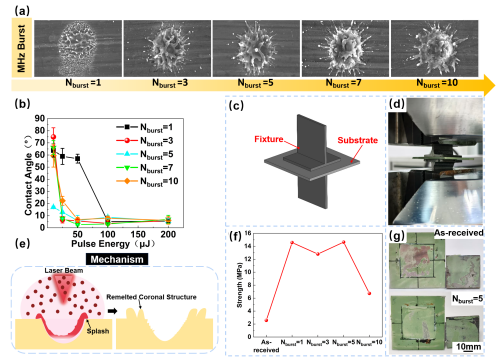
Figure 2: (a) SEM morphological evolution under different numbers of pulse bursts, Nburst; (b) Contact angle versus single-pulse energy; (c) Schematic diagram of the peel adhesion test apparatus; (d) Physical photograph of the mechanical testing apparatus; (f) Adhesion strength as a function of the number of pulse bursts, Nburst; (e) Schematic illustration of the formation mechanism of the laser‑induced “sputter‑like” hierarchical structure; (g) Comparative analysis of cross‑sectional failure morphologies under various conditions.
Source: Shanghai Institute of Optics and Fine Mechanics
LATEST NEWS
Thank you for visiting the official website of Chongfan Technology. If you have cooperation intentions or suggestions, please contact us through the following methods, and we will reply as soon as possible, thank you!
Address: Room 403, Building 6, Phase III of R&D, No. 36 Xiyong Avenue, High tech Zone, Chongqing, China.
Telephone: +86-13658337211
E-mail: Sales@cfkeji.net
Website: www.cfkeji.net
Mobile Version