
Chongfan Technology
News
18
2026
-
05
Researchers may have discovered the descendants of the “small red dot” galaxies from the early universe.
Author:
“Red dots” are a newly discovered class of compact, red objects in the very early universe, characterized by their distinctive “V-shaped” spectra and dense morphologies. Although the nature of these objects remains controversial, most researchers contend that their luminosity is primarily powered by the intense accretion activity of supermassive black holes at their centers. Even more puzzling is that, when the universe was still in its infancy, the masses of these black holes appear to vastly exceed those of their host galaxies—contradicting the well-established black hole–galaxy mass relation observed in the present-day universe. To overcome the limitations of high-redshift observations, the research team leveraged DESI’s extensive spectroscopic dataset to conduct a systematic search in the relatively nearby cosmos.
The research team screened nearly 18 million astronomical spectra from the DESI survey and ultimately identified five low-redshift analogs. These objects closely resemble the high-redshift “small red dots” in both their morphological and spectral characteristics. While the number of LRDs in the high-redshift universe is quite substantial, the discovered low-redshift analogs are exceedingly rare. The key to this discovery lies in the unprecedented depth and breadth of spectral coverage provided by DESI data, which made this needle-in-a-haystack search feasible.
Further analysis reveals deeper scientific implications. Although these low-redshift analogs host black holes comparable in mass to their high-redshift counterparts, their host galaxies are 2 to 3 orders of magnitude more massive, indicating that they have reverted to the classical cosmic black hole–stellar mass scaling relation and no longer exhibit the extreme deviations observed in the early universe. The presence of narrow emission-line features suggests that they reside in galaxy environments with higher metallicities and more advanced chemical evolution, strongly implying that they may be descendants of the high-redshift LRD population following a prolonged evolutionary phase.
The greatest value of this work lies in its linking the exotic objects discovered by the James Webb Space Telescope during the universe’s “cosmic infancy” with the objects we can now dissect in detail in our own “cosmic backyard.” These five low-redshift analogs offer a new observational window for understanding the co-evolution of black holes and galaxies.
At present, research has yet to definitively determine whether these newly discovered low-redshift analogs are the evolutionary descendants of high-redshift LRDs. In the next phase, we will integrate multi-wavelength observational data and conduct follow-up high-resolution spatial observations to precisely characterize the physical properties of these objects, thereby systematically investigating their potential evolutionary connections with the early “small red dots.” This work is of crucial importance for elucidating the origins and growth mechanisms of supermassive black holes in the early universe.
Ding Weiyu, a doctoral student jointly trained by the University of Science and Technology of China and the National Astronomical Observatories of the Chinese Academy of Sciences, is the first author of the paper. Researcher Zou Hu of the National Astronomical Observatories of the Chinese Academy of Sciences and Professor Kong Xu of the University of Science and Technology of China serve as the co-corresponding authors.
Paper link: https://doi.org/10.1051/0004-6361/202557889
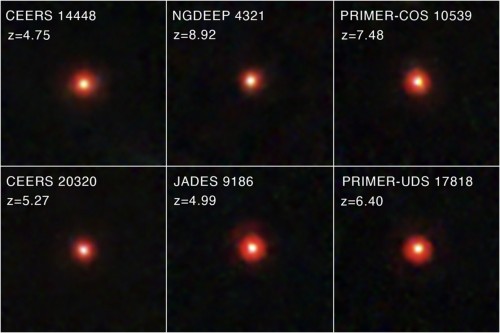
Figure 1. The “little red dots” galaxies in the early universe discovered by the James Webb Space Telescope (JWST). These objects appear extremely compact and reddish in the images, and may harbor actively accreting supermassive black holes within them (image courtesy of NASA).
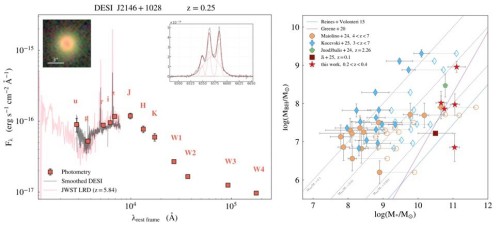
Figure 2. Left panel: Optical and spectroscopic properties of DESI J2146+1028. This object is a typical low-redshift “small red dot” analog, exhibiting a compact optical morphology and broad emission lines similar to those of high-redshift LRDs. Right panel: Comparison of the relationship between central black hole mass and host galaxy stellar mass. In contrast to high-redshift LRDs, which generally deviate from the canonical relation with “overmassive black holes,” this study finds that although the black hole masses of low-redshift analogs are comparable in magnitude, their host galaxy masses are significantly higher—by about 2–3 orders of magnitude—and closely follow the distribution observed for low-redshift active galactic nuclei (AGN). This evolutionary trend strongly suggests that such low-redshift objects may represent the late stage of high-redshift LRDs after prolonged evolution.
Source: National Astronomical Observatories
LATEST NEWS
Thank you for visiting the official website of Chongfan Technology. If you have cooperation intentions or suggestions, please contact us through the following methods, and we will reply as soon as possible, thank you!
Address: Room 403, Building 6, Phase III of R&D, No. 36 Xiyong Avenue, High tech Zone, Chongqing, China.
Telephone: +86-13658337211
E-mail: Sales@cfkeji.net
Website: www.cfkeji.net
Mobile Version