
Chongfan Technology
News
09
2026
-
04
The team at the Institute of Optics and Electronics has developed a high-performance O3 sensor based on a patterned ITO film.
Author:
A research team led by Researcher Meng Gang at the Anhui Institute of Optics and Fine Mechanics, Chinese Academy of Sciences, in collaboration with Professor Lu Huadong from Shanxi University and Professor Guo Qingchuan’s team at Anhui University, has developed an ozone (O3) sensor based on a patterned indium tin oxide (ITO) film. Using conventional ITO-coated glass as the substrate and employing femtosecond laser ablation combined with plasma etching, the researchers engineered this sensor. Leveraging a unique self-heating design and plasma surface-modification techniques, the sensor achieves precise, rapid, and stable detection of O3 at the ppb level (parts per billion). The findings have been published in Nano Letters under the title “Self‑Heating of Top‑Down Manufactured ITO Sensors for Accurately Monitoring ppb‑Level O3.”
Near-surface ozone pollution remains a key focus of current atmospheric monitoring, driving intense interest in the development of miniature, ambient-level (ppb) O3 sensors. Addressing the challenges faced by conventional metal-oxide-semiconductor (MOS) ozone sensors—namely, external heating that leads to ozone decomposition, significant humidity interference, and poor batch-to-batch consistency at the wafer level—the research team has proposed a novel top-down, self-heating ITO sensor fabrication strategy. This process uses commercially available ITO-coated glass as the substrate and employs femtosecond laser ablation to create a serpentine electrode architecture. Subsequently, argon–hydrogen (Ar/H2) plasma etching is used to roughen the smooth ITO film, thereby enhancing O3 adsorption and charge exchange. Following laser dicing, the final device is a compact ozone sensor measuring only 1.4 × 2.1 × 0.3 mm³. Importantly, this sensor requires no external heating; instead, it achieves localized self-heating of the sensing region to 180°C, effectively preventing the decomposition and consumption of O3 molecules in the surrounding environment. The ITO-based sensor exhibits high selectivity for O3 and minimal sensitivity to ambient humidity, enabling accurate measurements across the 20–1000 ppb range, with a correlation coefficient of 93.6% when compared with the international “gold-standard” ultraviolet absorption analyzer (Figure 1).
This sensor features a simple fabrication process that enables wafer-level mass production with high performance consistency (Figure 2), thereby meeting the requirements for high-resolution, grid-based monitoring of ambient O3 pollution both indoors and outdoors.
Ph.D. student Ji Xiaohua is the first author of the paper, and Researcher Meng Gang is the corresponding author. This research was supported by the National Natural Science Foundation of China, the Anhui Provincial Science and Technology Breakthrough Program, the Wanjiang Emerging Industries Technology Development Center, and the State Key Laboratory of Quantum Optics and Quantum Devices.
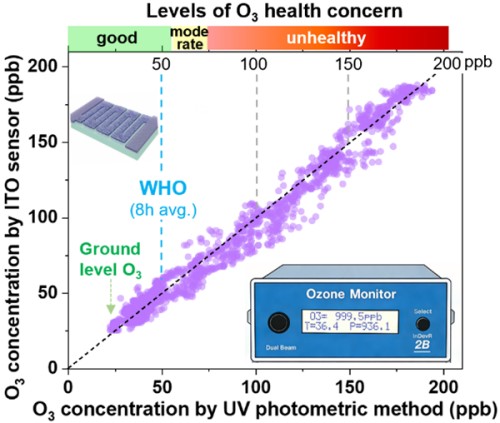
Figure 1: Performance Comparison Between Self-Heated ITO Sensors and Optical Ozone Detectors
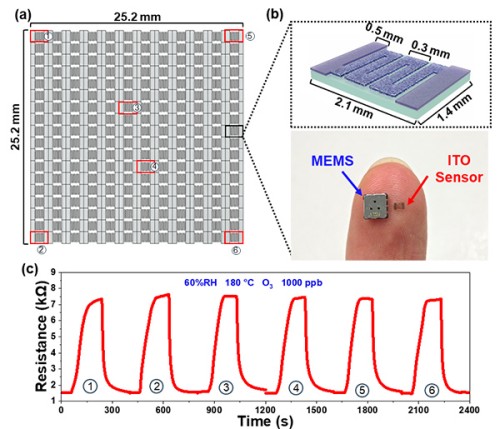
Figure 2: Batch Fabrication of ITO Sensors and Consistency of O3 Response
Source: Anhui Institute of Optics and Fine Mechanics
LATEST NEWS
Thank you for visiting the official website of Chongfan Technology. If you have cooperation intentions or suggestions, please contact us through the following methods, and we will reply as soon as possible, thank you!
Address: Room 403, Building 6, Phase III of R&D, No. 36 Xiyong Avenue, High tech Zone, Chongqing, China.
Telephone: +86-13658337211
E-mail: Sales@cfkeji.net
Website: www.cfkeji.net
Mobile Version