
Chongfan Technology
News
07
2026
-
04
The Shanghai Institute of Optics and Fine Mechanics has made progress in research on lattice doping of TAG magneto-optical transparent ceramics for optical isolators in high-energy laser systems.
Author:
Recently, the research team led by Researcher Jun Wang at the Q&Q+ Research Center of the Shanghai Institute of Optics and Fine Mechanics, Chinese Academy of Sciences, has made progress in the study of Mg- and Si-co-doped TAG magneto-optical ceramics. The relevant findings have been published in the Journal of the European Ceramic Society under the title “Roles of non-stoichiometric Mg2+-Si4+ co-doping in the sintering process of TAG ceramics with higher optical quality.”
Terbium aluminum garnet (TAG) ceramics have emerged as a highly promising magneto-optical material for high-power Faraday isolators, owing to their high Verdet constant, high thermal conductivity, and high transmittance across the visible to near-infrared spectral range. Compared with conventionally used commercial TGG single crystals, TAG ceramics exhibit a Verdet constant approximately 30% higher and a thermal conductivity about 14% greater. Previous studies on ceramic sintering have demonstrated that when the silicon ion content added as a sintering aid exceeds 300 ppm, it markedly promotes the formation of grain-boundary phases and leads to the precipitation of silica at the grain boundaries; at a silicon ion concentration of 930 ppm, the thickness of these grain-boundary phases can reach 80 nm. Such grain-boundary phases give rise to scattering losses, thereby reducing laser transmission efficiency. Consequently, when the porosity of the ceramic is extremely low, its laser performance is largely determined by the amount of grain-boundary phases present. Earlier research by the team revealed that, although XRD analysis indicated a pure-phase microstructure and scanning electron microscopy showed no obvious secondary phase, energy-dispersive X-ray spectroscopy still detected segregation of Mg and Si at the grain boundaries when TEOS and MgO were added as a composite sintering aid in a mass-ratio formulation. To address this issue, the research team designed experiments involving non-stoichiometric Mg2+-Si4+ site doping, which proved effective in reducing the residual phase at the grain boundaries and enhancing the optical quality of transparent TAG ceramics—outperforming conventional single-component sintering aids added in a mass-ratio manner.
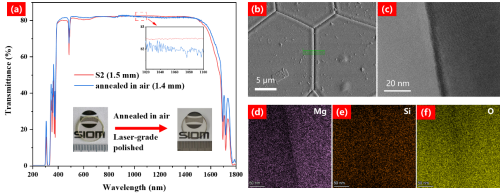
Figure 1: Photograph and transmittance curve of TAG ceramic, along with TEM images and elemental analysis of the grain boundaries.
The research team conducted an in-depth analysis of the intrinsic mechanisms underlying non-stoichiometric Mg2+-Si4+ site doping and carried out further experimental validation. Through systematic investigation, they elucidated the solid-solution behavior of Mg2+ and Si4+ at different sintering stages and revealed the correlations between this behavior and ceramic densification, phase evolution, and grain-boundary microstructure. Analysis of lattice parameters and oxygen-vacancy concentrations showed that Si4+ enters the lattice earlier than Mg2+, and as temperature increases, the presence of Si4+ in turn enhances the solid-solution capacity of Mg2+. By precisely tuning the atomic ratio of magnesium to silicon, the team achieved optimized control over the ceramic densification process. Transmission electron microscopy analysis of the grain boundaries in the optimal sample demonstrated that, under conditions of high additions of MgO and TEOS, this non-stoichiometric lattice-design approach can significantly reduce residual grain-boundary phases; the figure shows that the thickness of these additional grain-boundary phases is less than 5 nanometers and is virtually undetectable. This finding confirms that, under non-stoichiometric doping conditions, synergistic optimization of the type and content of sintering aids is crucial for fabricating garnet-based transparent ceramics with superior optical quality.
Source: Shanghai Institute of Optics and Fine Mechanics
LATEST NEWS
Thank you for visiting the official website of Chongfan Technology. If you have cooperation intentions or suggestions, please contact us through the following methods, and we will reply as soon as possible, thank you!
Address: Room 403, Building 6, Phase III of R&D, No. 36 Xiyong Avenue, High tech Zone, Chongqing, China.
Telephone: +86-13658337211
E-mail: Sales@cfkeji.net
Website: www.cfkeji.net
Mobile Version