
Chongfan Technology
News
16
2026
-
09
Mechanically Programmable Chiral Optical Waveguide Based on Stretchable Photonic Crystal Fiber
Author:
The He-Lou Xie team at Xiangtan University and the Pengfei Duan team at the National Center for Nanoscience and Technology have reported a mechanically programmable chiral optical waveguide based on stretchable photonic crystal (SPC) fibers. By establishing a rigorous quantitative relationship between the evolution of the helical pitch and the circular polarization luminescence (CPL) asymmetry factor, the authors can linearly tune the latter from 0.153 to nearly zero through mechanical stretching. The fiber exhibits an exceptionally low optical loss coefficient (~0.0922 dB/mm), ensuring signal integrity over long transmission distances. Moreover, the signal enables a “self‑calibrating” sensing mode that is intrinsically robust against fluctuations in excitation intensity and environmental scattering, thereby overcoming the fundamental limitations inherent in conventional light‑intensity‑based sensors. This work deepens our understanding of strain‑responsive photonic structures and provides a robust platform for high‑precision, interference‑resilient human motion monitoring and multi‑channel optoelectronic communication.
The research findings were published in Nature Communications on August 13, 2026, under the title “Circularly polarized luminescence optical waveguides in stretchable photonic crystal fibers for advanced human motion monitoring.”
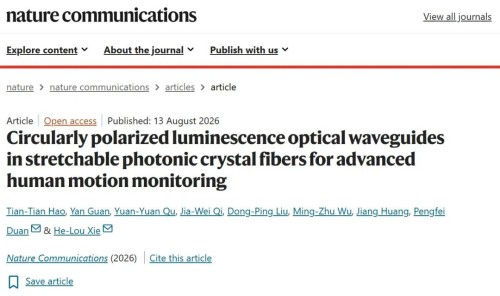
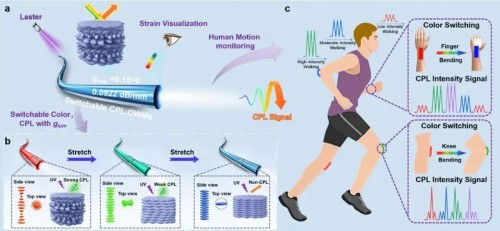
Figure 1: Schematic illustration of the circularly polarized luminescence (CPL) waveguide behavior of the SPC@x%LC756 optical fiber.
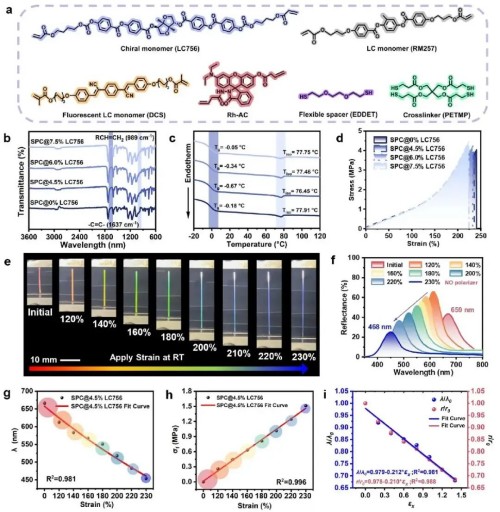
Figure 2: Fabrication and characterization of stretchable photonic crystal (SPC) fibers.
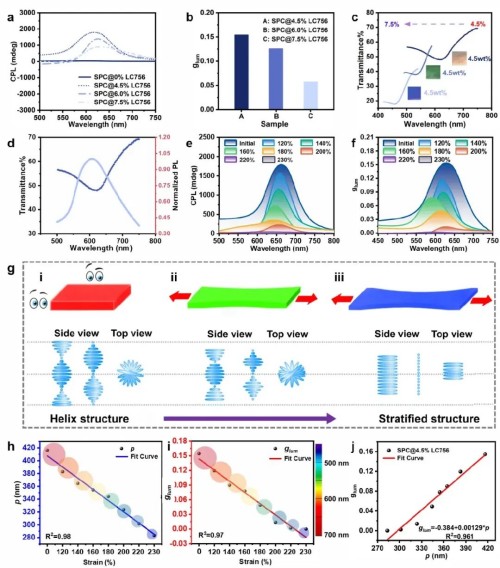
Figure 3: Photophysical properties of SPC optical fibers and dynamic modulation of their CPL characteristics.
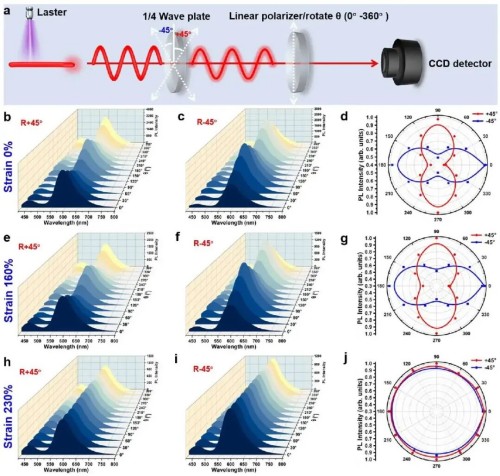
Figure 4: CPL optical waveguide characteristics of SPC fiber under dynamic tensile loading.
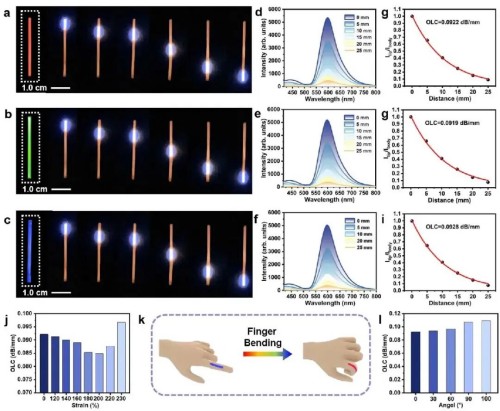
Figure 5: Fluorescence spectra and optical loss analysis of SPC optical fiber
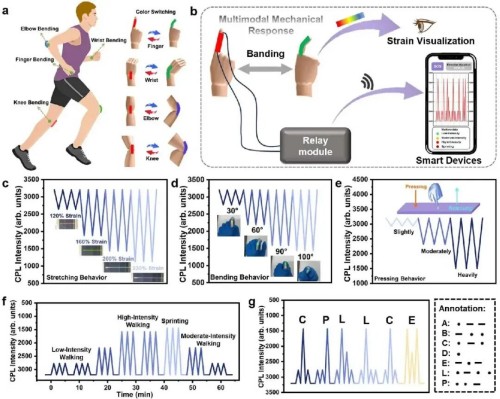
Figure 6: Application of a CPL optical waveguide based on SPC fiber in human motion monitoring.
Source: Optics World
Thank you for visiting the official website of Chongfan Technology. If you have cooperation intentions or suggestions, please contact us through the following methods, and we will reply as soon as possible, thank you!
Address: Room 403, Building 6, Phase III of R&D, No. 36 Xiyong Avenue, High tech Zone, Chongqing, China.
Telephone: +86-13658337211
E-mail: Sales@cfkeji.net
Website: www.cfkeji.net
Mobile Version