
Chongfan Technology
News
06
2026
-
08
On-chip hollow-core waveguide
Author:
The team of Markus A. Schmidt at the University of Jena has proposed a unique on-chip hollow-core waveguide that confines light within a support‑membrane structure composed predominantly of air, achieving an cladding openness as high as 80% while maintaining optical losses comparable to those of fully enclosed waveguides. Light guidance in this photonic scaffold is realized through a combination of anti‑resonant confinement and the emergence of Bloch modes in its segmented architecture. High‑precision 3D nanofabrication, comprehensive optical characterization, and a resonator‑based theoretical model have validated both its guiding mechanism and loss characteristics. The authors demonstrate its practical utility by enabling enhanced molecular diffusion, highly integrated optofluidic spectroscopy, and efficient single‑photon transmission enabled by the open scaffold structure and air‑dominated light guidance.
The research findings were published in Nature Communications on July 28, 2026, under the title “Photonic scaffolds as ultrahigh-openness on-chip hollow-core waveguides for quantum photonics and optofluidics.”
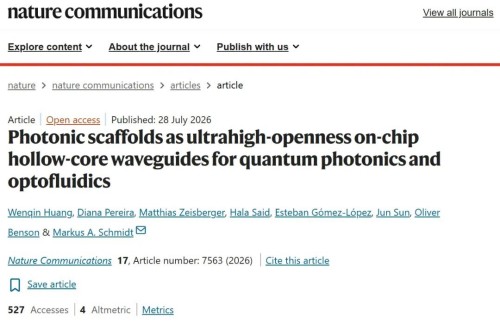
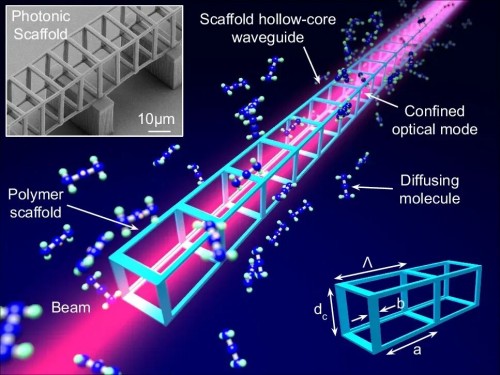
Figure 1: On-chip segmented hollow-core waveguide—artistic schematic of a photonic scaffold.
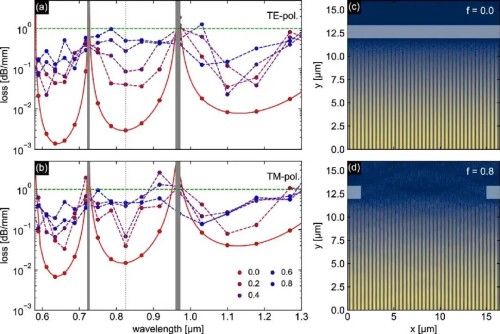
Figure 2: Analysis of cladding openness using a resonator model
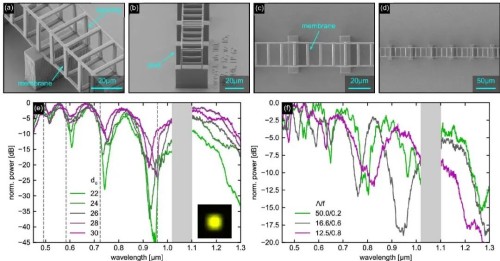
Figure 3: Experimental characterization of the Type I photonic scaffold.
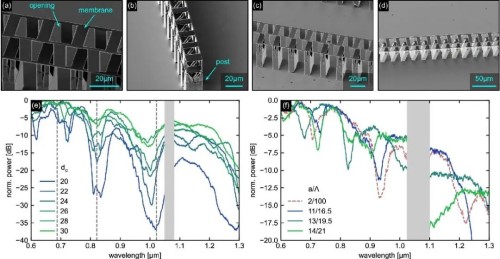
Figure 4: Experimental characterization of Type II photonic scaffolds
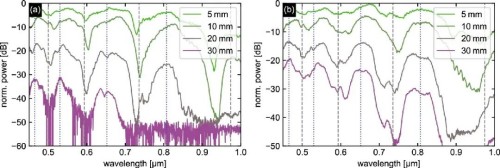
Figure 5: Length-dependent transmittance of Type-I photonic scaffolds
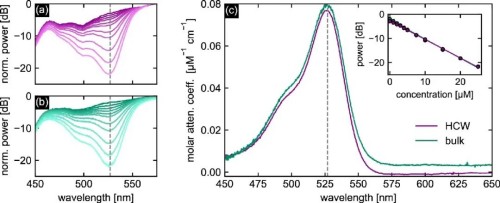
Figure 6: First application example: Absorption of Rhodamine 6G in water-filled sHCWs.
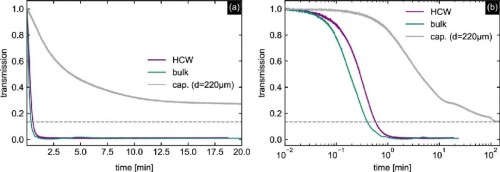
Figure 7: Second application example: Temporal characterization of dye diffusion
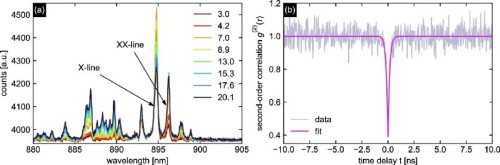
Figure 8: The third demonstration application: single-photon transmission
Source: Optics World
LATEST NEWS
Thank you for visiting the official website of Chongfan Technology. If you have cooperation intentions or suggestions, please contact us through the following methods, and we will reply as soon as possible, thank you!
Address: Room 403, Building 6, Phase III of R&D, No. 36 Xiyong Avenue, High tech Zone, Chongqing, China.
Telephone: +86-13658337211
E-mail: Sales@cfkeji.net
Website: www.cfkeji.net
Mobile Version
