
Chongfan Technology
News
13
2026
-
07
Single-shot imaging of a phase object fully enclosed by a dynamic scattering layer
Author:
The team led by Mooseok Jang at the Korea Advanced Institute of Science and Technology has transformed the problem of random scattering into a deterministic holographic imaging task by introducing a tightly focused illumination scheme that minimizes the number of spatial modes transmitted through the forward scattering layer. Leveraging this deterministic forward‑propagation physics, the authors have developed a physically guided joint optimization framework capable of simultaneously reconstructing phase objects and estimating unknown system parameters—namely, the scattering blur kernel and propagation distance—from a single intensity measurement, without requiring separate calibration of these parameters. Experimental results demonstrate that this approach enables robust phase imaging of objects fully embedded within two dynamic scattering layers, with a memory effect as low as 0.2°. To the authors’ knowledge, this work presents a technique that exploits the spatial coherence of scattering layers, opening a new avenue for applications such as metrology and detection through scattering media.
The research findings were published in Optica on July 1, 2026, under the title “Single-shot imaging of phase objects fully enclosed by dynamic scattering layers.”
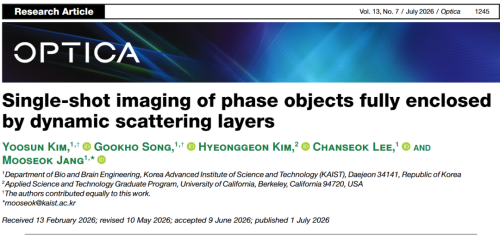
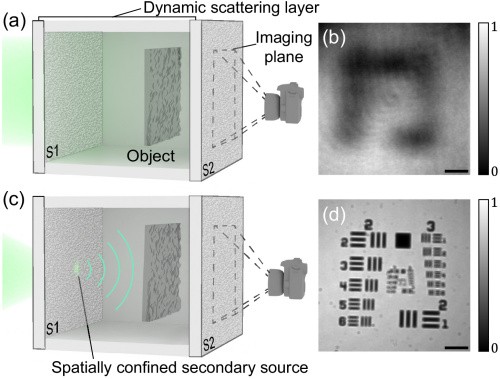
Figure 1: Comparison of intensity images obtained from dynamic scattering layer measurements under different illumination conditions.
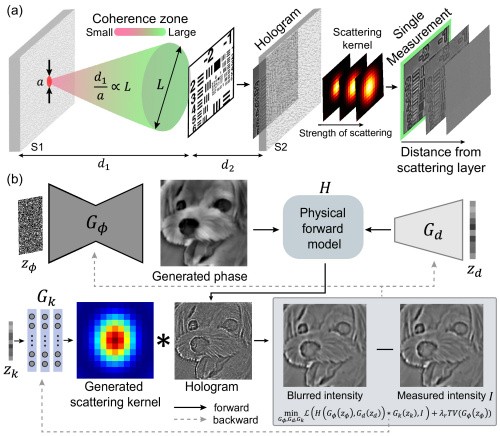
Figure 2: Holographic Encoding and Reconstruction Framework Based on Dynamic Scattering
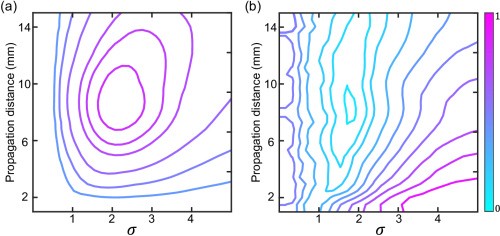
Figure 3: (a) SSIM between the reference intensity at a propagation distance of 8 mm and σ = 2, and the simulated intensity in the distance parameter space σ.
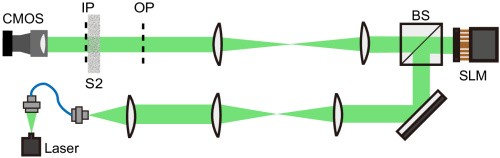
Figure 4: Experimental setup Figure 5: (a) Relationship between the spacing of two layers of Scotch tape and the FWHM of the true value of the scattering blur kernel.
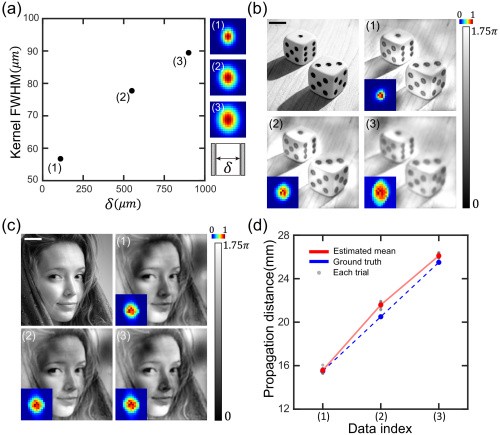
Figure 6: Performance Comparison of Phase Reconstruction Algorithms
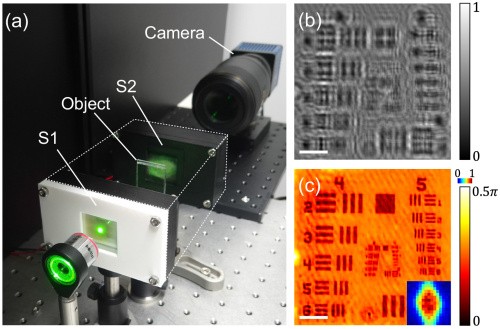
Figure 7: (a) Experimental setup containing S1 and S2
Source: Optics World
LATEST NEWS
Thank you for visiting the official website of Chongfan Technology. If you have cooperation intentions or suggestions, please contact us through the following methods, and we will reply as soon as possible, thank you!
Address: Room 403, Building 6, Phase III of R&D, No. 36 Xiyong Avenue, High tech Zone, Chongqing, China.
Telephone: +86-13658337211
E-mail: Sales@cfkeji.net
Website: www.cfkeji.net
Mobile Version