
Chongfan Technology
News
12
2026
-
06
Dynamic Tunable Metasurfaces for Infrared Spectroscopy and Strong Light–Matter Interactions
Author:
The team led by Filiz Yesilkoy at the University of Wisconsin–Madison presents and demonstrates a dynamically tunable silicon‑membrane metasurface that exhibits high‑quality-factor (Q) transmission resonances in the fingerprint region. By leveraging the thermo‑optic properties of silicon, the authors achieve continuous tuning of a coupling‑induced transparency (CIT) mode, which arises from the interference between quasi‑continuous bound states in the continuum (q‑BIC) and surface lattice modes (SLM). Across a temperature range of 300–700 K, they continuously scan a sharp CIT resonance spanning 23.5 cm⁻¹, measuring a spectral tuning rate of 0.06 cm⁻¹·K⁻¹. In this proof‑of‑concept implementation, dynamic transmission control enables the detection of characteristic absorption bands of polystyrene (at 1450 and 1492 cm⁻¹) and polymethyl methacrylate (at 1730 cm⁻¹) without the need for conventional spectrometers, thereby enabling non‑contact chemical analysis of polymer films. When analyte molecules populate the photonic cavity formed by the metasurface, the authors demonstrate strong vibrational coupling between the carbonyl band of polymethyl methacrylate and the CIT mode, manifesting as a Raman‑shifted splitting of approximately 43 cm⁻¹. These results establish a novel photonic platform that combines spectral precision, strong field enhancement, and reconfigurability, opening up diverse possibilities for compact mid‑infrared spectroscopy, molecular sensing, and programmable polariton photonics.
The research findings were published on June 9, 2026, in Light: Science & Applications, under the title “Dynamically tunable membrane metasurfaces for infrared spectroscopy and strong light-matter interactions.”
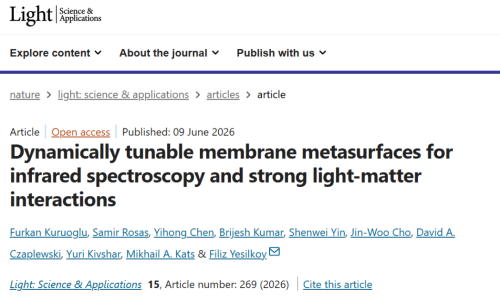
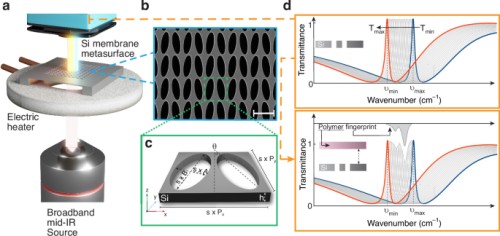
Figure 1: Dynamically tunable silicon‑membrane metasurface for mid-infrared spectroscopy
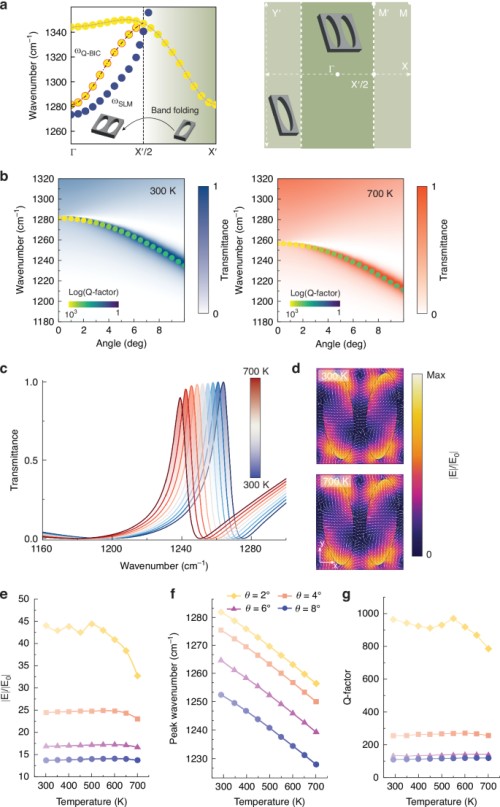
Figure 2: Thermal tuning simulation results for the q-BIC-CIT resonant mode.
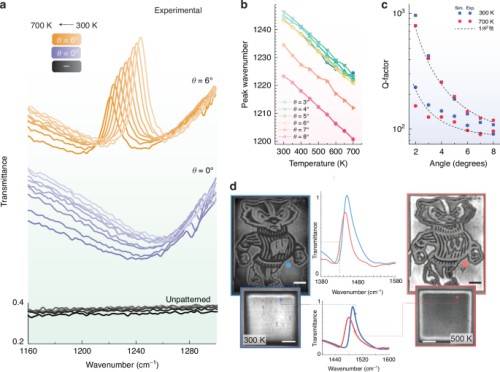
Figure 3: Experimentally measured thermal tuning effect of the photon q-BIC-CIT mode.
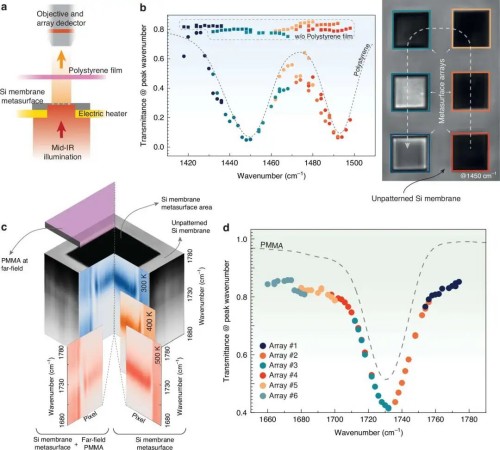
Figure 4: Non-contact chemical analysis of a polymer thin film positioned in the optical path, using a dynamically tunable metasurface.
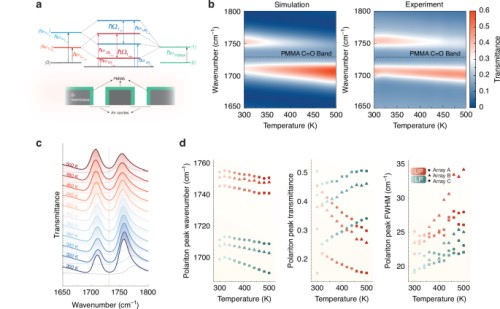
Figure 5: Near-field strong coupling of vibrations achieved using a dynamically tunable metasurface.
Source: Optics World
LATEST NEWS
Thank you for visiting the official website of Chongfan Technology. If you have cooperation intentions or suggestions, please contact us through the following methods, and we will reply as soon as possible, thank you!
Address: Room 403, Building 6, Phase III of R&D, No. 36 Xiyong Avenue, High tech Zone, Chongqing, China.
Telephone: +86-13658337211
E-mail: Sales@cfkeji.net
Website: www.cfkeji.net
Mobile Version