
Chongfan Technology
News
21
2026
-
05
China has successfully developed an ultra-wideband photonic chip that can be scaled up for satellite‑borne communications.
Author:
According to an announcement from the “China Optics Valley” official account, the National Information Optoelectronics Innovation Center (hereinafter referred to as the “Center”) has independently developed an ultra‑wideband photonic chip that, with a bandwidth of 250 gigahertz, has set a new record for data transmission capacity.
Zhang Hongguang, manager of the Center’s Future Technologies Department, explained: “The smartphones and computers we use every day process information using electrical signals, while long-distance data transmission requires converting these signals into optical ones. Photonic chips handle both ‘electrical‑to‑optical’ and ‘optical‑to‑electrical’ conversion, serving as two critical building blocks for transmitting and receiving in optical communication links. The greater the chip’s bandwidth, the more data it can carry and transmit in a single second.”
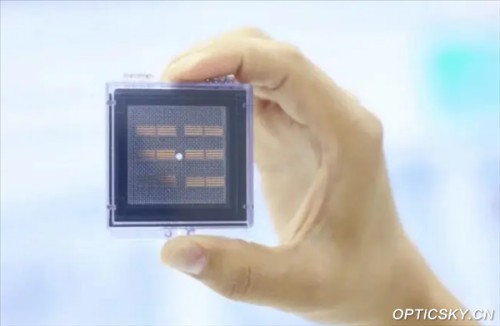
In fiber-optic communication networks, the bandwidth of photonic chips often represents the bottleneck for data transmission. This breakthrough in chip bandwidth will provide robust technical support for high-speed data transfer.
Currently, leveraging this chip, the project team has pioneered cross‑network integration between fiber‑optic and wireless communication systems: fiber‑optic wired transmission rates have exceeded 512 gigabits per second—equivalent to downloading over a dozen high‑definition movies in just one second—while terahertz wireless transmission has reached 400 gigabits per second, capable of simultaneously delivering 8K ultra‑high‑definition video streams to 86 users.

Zhang Hongguang stated that, leveraging this chip technology, the center has developed the world’s first 170‑GHz intensity modulator and successfully integrated it into domestically produced optoelectronic measurement equipment.
In the future, this chip will provide foundational support for 6G’s “integrated space–air–ground” communications and is expected to extend further into the field of on‑board satellite communications, thereby bolstering the development of domestically produced satellite communication equipment.
Source: China Optics Valley
LATEST NEWS
Thank you for visiting the official website of Chongfan Technology. If you have cooperation intentions or suggestions, please contact us through the following methods, and we will reply as soon as possible, thank you!
Address: Room 403, Building 6, Phase III of R&D, No. 36 Xiyong Avenue, High tech Zone, Chongqing, China.
Telephone: +86-13658337211
E-mail: Sales@cfkeji.net
Website: www.cfkeji.net
Mobile Version