
Chongfan Technology
News
23
2026
-
07
Precise control of perovskites makes blue LEDs more vibrant.
Author:
Over the past decade, perovskite light-emitting diodes (LEDs) have become increasingly vibrant in color while their production costs have steadily declined. By finely tuning their chemical composition, these crystal-based emissive materials can be tuned across the entire visible spectrum—achieving performance in red and green emission that rivals, and in some cases even surpasses, that of conventional LED counterparts. However, blue light has remained a persistent challenge, preventing the realization of full‑color perovskite displays. In a new study published in Nature, a team led by Xuyong Yang at Shanghai University has now identified a pathway to overcome this hurdle: their perovskite LEDs not only emit bright, highly saturated blue light but also exhibit significantly longer lifetimes than previously reported devices.
Blu-ray gap
The allure of perovskites lies in their crystal structure, which consists of a repeating lattice of charged atomic clusters. By altering the constituents that populate this lattice, one can readily tune the color of the light emitted by the material—and because these crystals can be grown from solution, they are also relatively inexpensive and easy to manufacture on a large scale.
However, blue light requires a wider bandgap between the material’s electronic states. To overcome this gap, a higher voltage must be applied to the device, which imposes electrical stress, destabilizes the fragile ionic lattice, and leads to rapid degradation. As a result, blue perovskite LEDs have thus far been dimmer and less durable than their red- and green‑emitting counterparts.
Enhance bonding flexibility
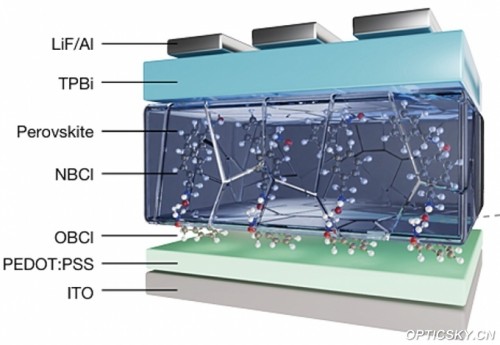
To address this issue, Yang Xuyong’s team first reinforced the crystal both externally and internally, employing two “isomers”—molecules with identical atomic compositions but distinct spatial arrangements. One isomer, OBCl, was introduced at the interface between the perovskite and the layer that supplies positive charge carriers, while the other isomer, NBCl, was directly incorporated into the perovskite matrix.
Previously, similar molecules used in perovskite design could only donate a single hydrogen atom for bonding, whereas OBCl and NBCl are distinct in that they can both donate and accept hydrogen atoms. This flexibility enables them to establish a richer network of hydrogen bonds throughout the crystal and at its interfaces, thereby stabilizing the perovskite structure, facilitating charge transport, and reducing, from the outset, the energy required to inject charge carriers.
The path to clearer full-color displays
The team’s device achieved an external quantum efficiency of 16.8% at the pure blue‑light wavelength, a metric that quantifies the conversion of electrical energy into usable light, and reached 22.0% at the slightly longer deep‑blue wavelength.
Although stability has also improved, the research team acknowledges that their devices currently operate for only a few hundred minutes—longer than previous deep-blue‑light designs but still far short of the requirements for display applications. Even so, this work represents a promising step forward for perovskite LEDs in terms of both stability and color quality. With further refinements, the team hopes their hydrogen‑bonding strategy will extend well beyond LEDs, finding applications in solar cells, sensors, and other devices.
Source: TechXplore
LATEST NEWS
Thank you for visiting the official website of Chongfan Technology. If you have cooperation intentions or suggestions, please contact us through the following methods, and we will reply as soon as possible, thank you!
Address: Room 403, Building 6, Phase III of R&D, No. 36 Xiyong Avenue, High tech Zone, Chongqing, China.
Telephone: +86-13658337211
E-mail: Sales@cfkeji.net
Website: www.cfkeji.net
Mobile Version